The Creatrepreneur Chronicles — by Kevin J. Barrett
March 28, 2026
First published on LinkedIn, March 28, 2026.
For much of the current AI conversation, intelligence is being framed in computational terms.
Prediction. Pattern recognition. Probability. Statistical modeling. Bayesian inference. Generative models.
Those frameworks are useful. They help explain important aspects of how both artificial systems and perhaps even parts of the human brain process information.
But I do not believe they tell the whole story of human intelligence.
And that matters.
Because the metaphor we choose for intelligence will shape the future we build.
If we define intelligence too narrowly, we will build systems that are powerful, but incomplete. Efficient, but potentially dehumanizing. Impressive, but disconnected from some of the deepest dimensions of what makes us human.
This is not a new thought for me.
In many ways, this conversation has been forming in me for a long time.
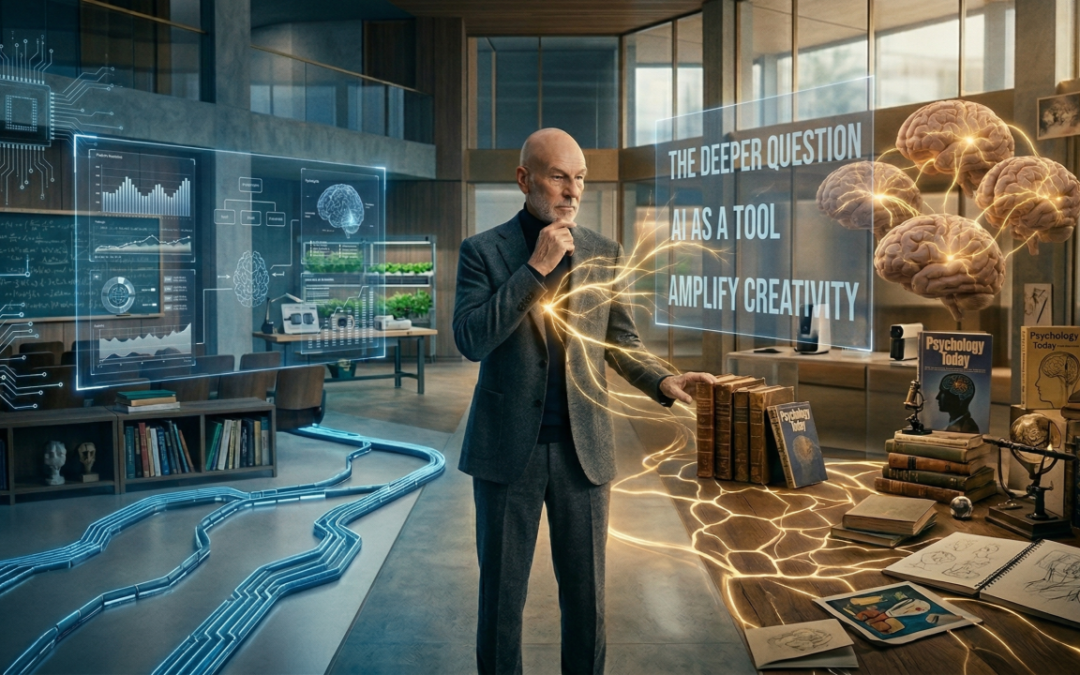
Even as a young lad, I was deeply interested in psychology. Psychology Today was one of my regular monthly reads. Long before AI became a public obsession, I was already fascinated by the workings of the mind, human potential, motivation, meaning, behavior, and the hidden forces that shape our lives.
That early curiosity never left me.
Since 1993, through business, coaching, education, entrepreneurship, and human development work, I kept seeing the same thing:
Human beings are not just rational processors of information.
We are not merely biological calculators.
We are not only conscious thinkers moving step by step through logic.
There is something more going on.
The limits of a purely statistical metaphor
Today, one of the dominant ways of thinking about intelligence comes from computational neuroscience and AI.
The brain, in this view, is often described as a prediction engine. A probabilistic model. A system that reduces error by updating its beliefs based on incoming information.
Again, I am not dismissing that.
There is real value in these models.
But I do question what happens when a useful model becomes an entire worldview.
Because when that happens, we can begin to confuse description with reality.
A map is not the territory.
A model is not the fullness of the phenomenon.
A statistical account of some aspects of cognition does not automatically explain insight, meaning, intuition, moral imagination, deep creativity, or the way breakthrough ideas often seem to arise from somewhere beyond linear conscious thought.
Many of us have experienced this directly.
An idea comes in the shower. A solution appears after sleep. A pattern becomes clear after letting go. A deeply felt knowing emerges before we can explain it.
Human beings often create not only through conscious analysis, but through a deeper interaction between conscious intention and what has traditionally been called the unconscious mind.
The unconscious is not a minor side note
To me, this is where the conversation becomes more interesting.
Much of human functioning appears to happen outside immediate conscious awareness. We know this not only from psychology, but from lived experience.
Our emotional responses, intuitions, associations, memories, habits, internal narratives, and creative gestation often operate beneath the surface before they arrive in awareness.
The point is not to make exaggerated claims.
The point is to resist reduction.
If human intelligence includes dimensions that are not fully captured by deliberate reasoning alone, then any future model of intelligence that ignores those dimensions will be incomplete.
And if it is incomplete, then the way we design AI, education, work, leadership, and society may also become incomplete.
That is one of my deeper concerns in the current moment.
Intelligence is not only output
We are living through a time when intelligence is increasingly being judged by visible performance.
Can it write? Can it code? Can it summarize? Can it reason? Can it answer quickly? Can it outperform?
But output is not the same as wisdom.
Speed is not the same as discernment.
Pattern completion is not the same as meaning.
And imitation is not the same as identity.
This matters because if we begin to treat human beings as if they are simply slower, less efficient versions of machines, we will end up building institutions that strip away dignity in the name of optimization.
Education will narrow. Work will become more extractive. Leadership will become more mechanical. And identity itself will be destabilized.
I have already been writing and speaking about this as a form of AI identity whiplash.
When people build their sense of self around a role, and AI begins to absorb parts of that role, the disruption is not only economic.
It is psychological. It is existential. It is spiritual.
That is why the conversation about intelligence cannot remain purely technical.
Co-Elevation: a different path
This is one reason I keep returning to the idea of Co-Elevation.
To me, the future should not be framed as humans versus AI.
Nor should it be framed as humans being reduced to the same logic we use to describe AI.
The better path is collaboration that elevates rather than diminishes.
Co-Elevation means using AI in ways that help human beings become more fully human, not less.
It means using technology to amplify creativity, reflection, discernment, contribution, and meaningful problem-solving.
It means designing systems that support human flourishing rather than replacing it with dependency.
It means acknowledging that even if AI becomes extraordinarily capable, there may still be uniquely human dimensions of intelligence that matter profoundly: meaning-making, moral choice, identity formation, embodied presence, deep intuition, care, conscience, purpose, and the ability to create from lived experience.
Those dimensions should not be treated as sentimental leftovers from a pre-technological age.
They may prove to be central.
Why this matters for education, business, and society
This perspective affects how I think about everything from entrepreneurship to education.
In business, it means we should not only ask what AI can automate, but what kind of value creation best serves people in a changing world.
In leadership, it means we should not only reward efficiency, but cultivate wisdom, judgment, and ethical clarity.
In education, it means we should not only prepare students to use AI tools, but help them understand themselves, develop agency, think deeply, and create meaningfully.
That is deeply connected to why I care about Qoollege, Creatrepreneurship, and the broader idea of a Creation Society.
If the future is built only around extraction, optimization, and concentration of power, we will produce more capability while losing something essential.
But if the future is built around contribution, creativity, ethics, and human development, then AI can become a partner in helping people unlock more of their potential.
That is a very different future.
A deeper question
So perhaps the central question is not simply:
What is AI capable of?
Perhaps the deeper question is:
What is human intelligence, really?
And from there:
What kind of relationship between human intelligence and artificial intelligence will be best for all concerned?
I do not claim to have the final answer.
Science itself is still grappling with consciousness, intelligence, creativity, and the nature of mind.
But I do believe this:
A purely statistical model of intelligence may be useful, but it is not enough.
Human beings are not merely prediction engines.
We are creators of meaning. We are interpreters of experience. We are shaped by layers of mind not yet fully understood. And we have the capacity to bring forth new realities through a combination of awareness, imagination, discipline, intuition, and purpose.
If that is true, then the future of AI should not be about replacing the human story.
It should be about helping us rise more fully into it.
That is the future I believe is worth building.
Ready to build with intention? Start here: thecreatrepreneur.com/start