
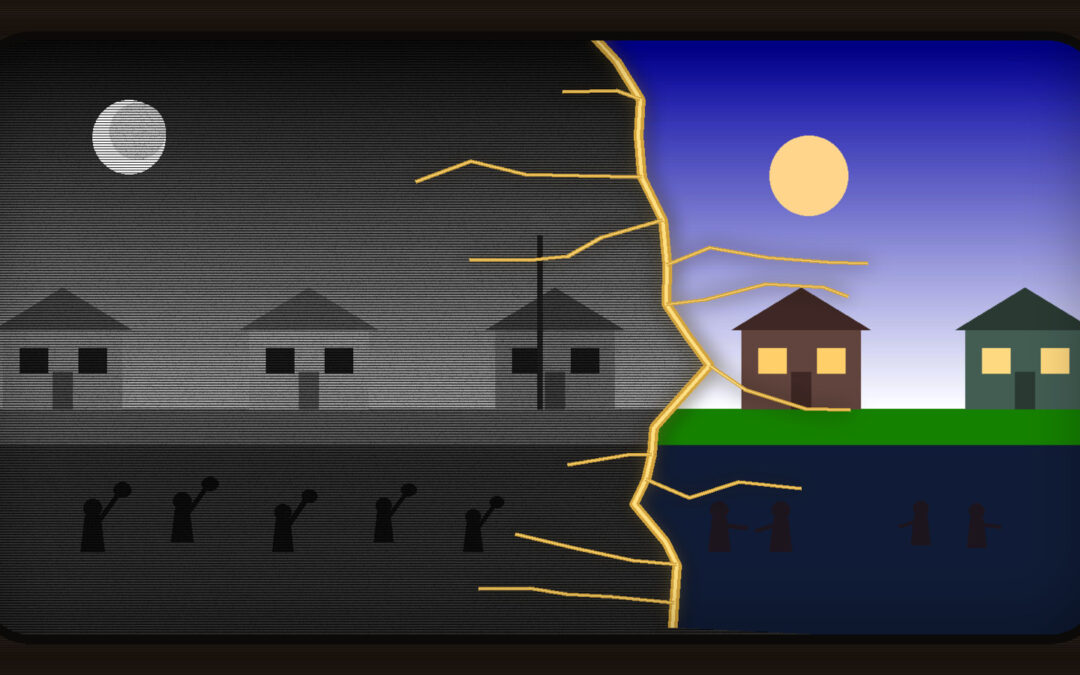
Information is not formation — what two days in a Rochester classroom drew out of a paperboy.
I. Five in the Morning, Rochester, New York
The alarm went off at five.
Two hundred and fifteen newspapers waited for me — the Democrat and Chronicle, stacked and banded, every morning for four years. Two hundred and fifteen doorsteps. Rain, lake-effect snow, the gray Rochester dark that doesn't lift until you've earned it.
I wasn't delivering papers for only spending money. I was also paying, part of my tuition. Aquinas Institute of Rochester was a private Catholic school, and my family's arrangement with it ran through my hands — one route, one morning at a time. Then school. Then practice; I played four sports. Home at six or seven in the evening. Then up at five to do it again.
I tell you this not for sympathy — I'd do every morning of it over again — but because it's the first half of a truth I've spent sixty years confirming:
Education you have a stake in is education that takes.
I wasn't a consumer of my schooling. I was an investor in it. Every paper I threw onto a porch was a brick in something I was building. And when you've paid for a classroom with your own dark mornings, you do not sit in that classroom passively.
Which brings me to the two days that changed my life.
II. Two Days on Maple Street
I was a freshman when a teacher at Aquinas did something that would be almost unthinkable in a school today.
He took a twenty-five-minute episode of television — Rod Serling's The Monsters Are Due on Maple Street, from The Twilight Zone — and gave it two full days of class time. Not to watch it. To take it apart.
If you don't know the episode: a quiet suburban street loses power on an ordinary afternoon. Lights die. Cars won't start. Then one neighbor's car starts by itself — and that's all it takes. Within hours, neighbors who have known each other for years are accusing each other of being the enemy in disguise. Suspicion picks its targets. Fear does the arguing. By nightfall there are rocks in hands and a man lies shot in the street — a neighbor, returning from a walk.
And the reveal: the real invaders never set foot on Maple Street. They simply flipped a few switches and watched. They didn't need weapons. They knew the neighbors would destroy each other, given a little darkness and a little doubt.
For two days, our teacher would not let us watch that story from the outside.
We debated it the way that school debated everything — the same way we would later spend days on "Better Red than Dead" as the Cold War tightened around our childhoods. Hard questions, face to face, no escape into easy answers. He kept turning the mirror around: Which neighbor are you? Don't tell me which one you'd like to be. Be honest. When the lights go out and the crowd is forming — which one are you?
I have never forgotten what that question drew out of me. And "drew out" is exactly the right phrase — it is, in fact, the oldest definition of education we have.
III. Educare: The Direction of the Flow
The word education comes from the Latin — e- meaning out, and ducere, to lead. To educate, in its root meaning, is to lead out what is already within a person. Not to pour in what is absent.
That distinction is not academic. It is the whole game.
Poured-in knowledge evaporates. Drawn-out knowledge becomes identity. The facts I memorized as a freshman are long gone. What those two days led out of me has steered every decade of my life since.
Because here is what I noticed, fourteen years old, walking out of that classroom:
Maple Street has no hero.
That is the episode's dark genius. There is no character who stands up and holds. The one reasonable voice gets shouted down early and joins the silence. The street is destroyed not by the invaders and not even by its loudest hothead — but by the absence of one steady person willing to say stop, wait, think and keep saying it.
The lesson that got drawn out of me wasn't in the story. It was the character the story was missing.
I walked out of that room with three sentences forming somewhere below conscious thought, sentences that the rest of my life has only reinforced:
Be a leader. Lead by example. One small voice with intent can change the world. And always — always — do the right thing.
I didn't know it then, but everything I would ever build was in those sentences. Decades later, when I formalized the principle that governs all my work — Best for All Concerned — I was writing down what a Catholic school classroom in Rochester led out of a fourteen-year-old paperboy in 1960. The provenance line is unbroken. That's what formation means.
IV. A Local Boy Made Good
There was one more reason those two days hit as hard as they did.
Rod Serling was one of ours.
Born in Syracuse, raised in Binghamton — upstate New York, our soil. To us he wasn't a distant Hollywood name. He was the local boy made good, living proof that someone from our gray corner of the world could shape the conscience of a nation armed with nothing but craft and conviction. That's what a hero is actually for. Not worship. Permission.
And look at the craft. Serling had tried to tell America's hardest truths straight, and the sponsors gutted him — scripts rewritten, meaning stripped, the truth sanded down until it offended no one and therefore reached no one. His answer was not surrender and it was not rage. He wrapped the truth in story. He built a vehicle — The Twilight Zone — that could carry the most uncomfortable mirrors past every gatekeeper, straight into America's living rooms, disguised as entertainment.
He took the fracture the censors made and filled it with craft. Readers of these Chronicles will recognize that move. It is kintsugi — gold in the crack — practiced before I had the word for it.
Serling's stories examined human beings at our base level and at our best, and insisted on the hardest truth of all: both live in each of us. The rock-thrower and the peacemaker share the same chest. Circumstance flips the switch. The work of a moral life is knowing that — and choosing, daily, which one answers the door.
To this day, when the marathons run every year, I sit down and watch as many episodes as I can. Sixty years on, I am still revisiting that curriculum. Mark that, because it matters for what comes next: poured-in content must be endlessly refreshed. Drawn-out understanding asks to be returned to.
V. The Anti-Aquinas
Now look at what we have built for our children.
The system forming young minds today is, point for point, the precise inversion of the one that formed me.
I had earned stake — my education cost me two hundred and fifteen doorsteps a morning, so none of it washed over me. The feed costs a child nothing, and so nothing about it takes root; it is infinite, free, and frictionless by design.
I had embodied discipline — the route, the four sports, the schedule that still wakes me before dawn at this age. The scroll asks for a slack body on a couch and a moving thumb.
I had educare — days of face-to-face debate where the question mattered more than the answer and a teacher kept turning the mirror around. The algorithm never debates a child. It agrees with them, harder and harder, feeding each mind its own custom diet of partial truths — and a partial truth aimed at a brain not yet fully formed doesn't just misinform. It malforms. The disconnects get built into the architecture.
And I had an exemplar — a local boy made good whose fame was built on moral craft. The feed supplies exemplars too. Look at what they're famous for.
Everything flows inward now. Nothing is drawn out. And a generation cut off from its own interior will believe any exterior story about who the neighbor is. That is Maple Street, scaled to a civilization. The lights flicker on every screen, every day — and the rocks are always within reach.
Here is the conclusion I refuse to flinch from: the polarization tearing at us is not, at root, an information problem. It is a formation problem. You cannot fact-check your way out of a population that was never led to find both the rock-thrower and the peacemaker within itself. The mob on Maple Street didn't lack information. It lacked formation. It lacked the two days.
VI. The SOULution: One Small Voice, Co-Elevated
So what do we do? Curse the algorithm? Smash the machines? That's just another crowd with rocks.
Serling already showed us the move. When the medium of his age was captured by manipulators, he didn't abandon the medium. He mastered it and made it carry conscience. The question of our age is whether we can do with AI what Serling did with television — take the most powerful medium ever built and make it serve the drawing-out of human beings instead of the pouring-in.
I believe we can, because I practice it every day. I call it the Co-Elevation of AI and HI — artificial intelligence and human intelligence, each raising the other. Used in extraction mode, AI is the algorithm's perfect servant: it confirms what you already believe, faster than ever. Used as a mirror, it is something else entirely — a tireless partner in the oldest educational act there is. It can ask you the question my teacher asked: which neighbor are you? It can hold your thinking up to the light, challenge your pattern, lead out of you what two days of debate once led out of me. The tool is neutral. The direction of flow is a choice.
And formation can be rebuilt. The elements are not mysteries — stake, discipline, debate, exemplars. Every one of them can be restored, in families, in classrooms, in the platforms we build, if we decide they matter. That decision is the work of my remaining years. It is why I build what I build in education. It is why these Chronicles exist.
These past years, life closed one of its circles. The paperboy who got up at five to pay for his formation went back to Aquinas — still close to the school, still in its community after all these decades — to give back to the place that built him, so that the next fourteen-year-old, standing in a storm of engineered half-truths my generation never faced, might have a structure that draws out instead of pours in.
Two hundred and fifteen papers a morning was the price of my educare. I am still paying the subscription. Gladly.
VII. Before You Pick Up the Rock
The neighbors on Maple Street could have simply walked across the lawn and talked to each other. They never did. Every system around you is now engineered to make sure you never do either.
So here is the practice, drawn from two days in 1960 and tested across sixty years:
Before you share, before you accuse, before you decide who the monster is — pause, and turn the mirror around. Ask which neighbor you are being right now. Not which one you'd like to be. Be honest. Both of them live in you. Both of them live in me. The whole moral life is in which one answers the door.
And when the lights flicker and the crowd starts forming — and they will, today, on some street or screen near you — remember what an upstate New York storyteller and a Rochester classroom led out of a paperboy a long time ago:
The street is never destroyed by the darkness. It is destroyed by the absence of one steady voice.
Be the missing character.
One small voice, with intent, can still change the world.
The fracture is the invitation. The drawing-out is the craft. Formation is the gold. The Creatrepreneur is the one who stays standing on Maple Street.
— Kevin J. Barrett, The Creatrepreneur Chronicles
If this piece was led out of anything, it was led out of two days at Aquinas Institute of Rochester, and a storyteller from Syracuse who proved that craft can carry conscience. Both have my gratitude, sixty years on.
P.S. — The Audit is the first rung of a ladder. When you're ready for the climb — the $27 Quick Start, the $50 Foundations Workbook — it all lives at thecreatrepreneur.com/start. No pressure and no countdown timer. The rung is simply there when you reach for it.
Every Chronicle is free, and will stay that way. When you're ready to move from reading to building, start here: thecreatrepreneur.com/start.