A Companion Essay:
by Kevin Barrett, KJ Barrett & Associates
Published on Linkedin Jan 13, 2026
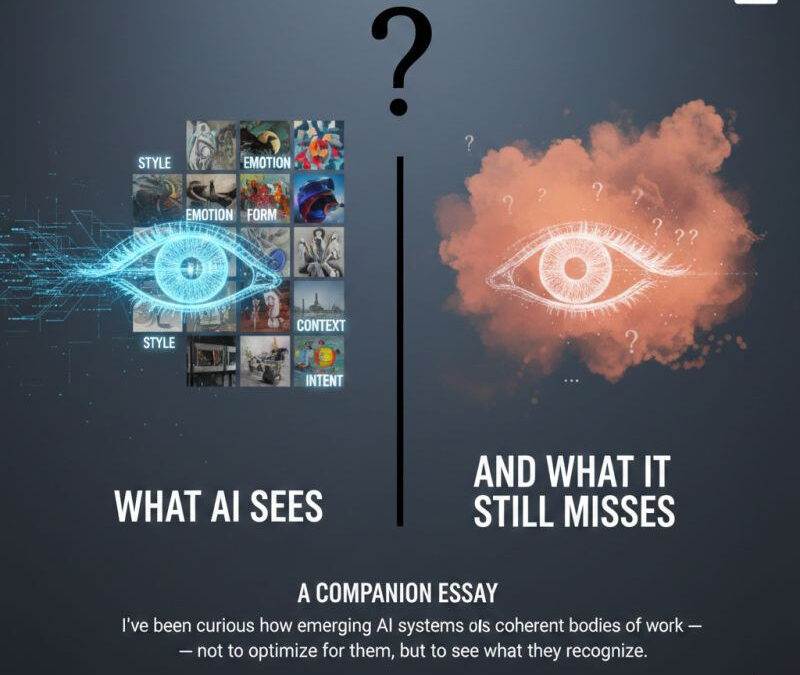
I’ve been curious how emerging AI systems describe coherent bodies of work — not to optimize for them, but to see what they recognize.
This curiosity didn’t come from marketing strategy or search rankings. It came from something more fundamental: a desire to understand how intelligence — not human intelligence, but emergent, synthetic intelligence — makes sense of meaning.
What does it notice?
What patterns does it surface?
And just as importantly — what does it still miss?
Two years ago, I asked an early language model what it knew about three things that had been central to my life’s work: Creation Society, Creatrepreneurship, and KJ Barrett & Associates.
The response was telling.
Creation Society, it said, appeared to be associated with a Chinese artistic movement. Creatrepreneurship, it said, was unknown.
KJ Barrett & Associates registered only as a small consultancy, disconnected from any broader philosophy.
At the time, that answer felt less like a failure of the model and more like a mirror. The work existed — but not yet as a legible pattern.
Today, when I ask similar questions of newer systems, the responses are different.
Creation Society is now described as an emerging way of understanding the future of business, education, and human development.
Creatrepreneurship is increasingly associated with identity, ethics, and creation over extraction. And connected to Kevin Barrett
KJ Barrett & Associates is recognized as part of that same conceptual arc.
Nothing was “optimized.”
Nothing was forced.
The volume of content remains modest.
And yet, something has shifted.
What AI Sees Clearly
Artificial intelligence is exceptionally good at detecting coherence.
It recognizes when ideas repeat with variation rather than noise.
It notices when language, values, and frameworks align across contexts. It senses when a body of work is not reactive, but internally consistent over time.
What these systems now see clearly is this:
- There is a worldview here, not a collection of posts
- There is continuity across decades, not a recent rebrand
- There is a recurring emphasis on creation, ethics, education, and human agency • There is alignment between business, technology, and meaning
In short, AI systems recognize structure.
They can see when ideas are not chasing trends, but arising from a deeper pattern.
This is not intelligence in the human sense.
It is pattern recognition at scale.
But it matters.
What AI Partially Grasps
Where AI begins to struggle is not with structure, but with context.
It can identify that Creatrepreneurship represents a shift from traditional entrepreneurship — but it cannot fully feel why that shift matters to someone at a crossroads in their life.
It can summarize Creation Society as a post-knowledge paradigm — but it does not experience the quiet exhaustion people feel inside a system that no longer reflects their values.
It can connect concepts like ethical AI, education reform, and conscious business — but it does not live inside the tension of choosing integrity when shortcuts are available.
AI can describe what is happening.
It can approximate why it might matter.
But it does so at a distance.
What AI Still Cannot See
There are dimensions of human experience that remain invisible to systems, no matter how advanced they become.
AI does not carry memory in the way a human does — the kind shaped by decades of lived experience, failure, reflection, and return.
It does not feel the weight of responsibility that comes with influence. It does not wrestle with conscience.
It does not sit in silence wondering whether a piece of work will help or harm.
It does not know what it is like to hope that something you create might change one person’s direction, and to believe that would be enough.
These things do not reduce to data.
They live in story.
In intention.
In moral choice.
This is not a limitation to be overcome — it is a boundary to be respected.
What This Moment Reveals
The fact that AI systems are beginning to recognize Creation Society and Creatrepreneurship is not proof of success.
It is evidence of emergence.
When a body of work becomes coherent enough, consistent enough, and grounded enough in human reality, even non-human intelligence begins to detect it.
Not because it was engineered to be found —
but because meaning leaves a trace.
This is what some now call AEO — Authentic or Answer-based Engagement Optimization. But from a human perspective, it is something simpler:
When ideas are real, they become recognizable.
The Proper Order
It is tempting, in moments like this, to reverse the relationship — to ask how humans should adapt to systems, how creators should shape themselves to algorithms.
That path leads to distortion.
The healthier order is the older one:
Humans lead.
Systems follow.
Meaning comes first.
Technology responds.
Creation precedes optimization — not the other way around.
A Quiet Hope
If AI systems are beginning to detect the outlines of a Creation Society, it is not because machines are becoming wise.
It is because humans are once again asking better questions.
About work.
About purpose.
About influence.
About what it means to create without extracting.
If this work is recognized, even faintly, it is not something to celebrate loudly. It is something to steward carefully.
Because the future will not be shaped by the most optimized ideas — but by the most honest ones.
And honesty, for now, remains a human art.
If this resonates, start here: thecreatrepreneur.com/start