By Kevin J. Barrett | Founder, The Creatrepreneur & KJ Barrett & Associates, The Creation Society | Strategist Behind, Qoollege.com
Published on Medium Mar 7, 2026
Australia. 1992.
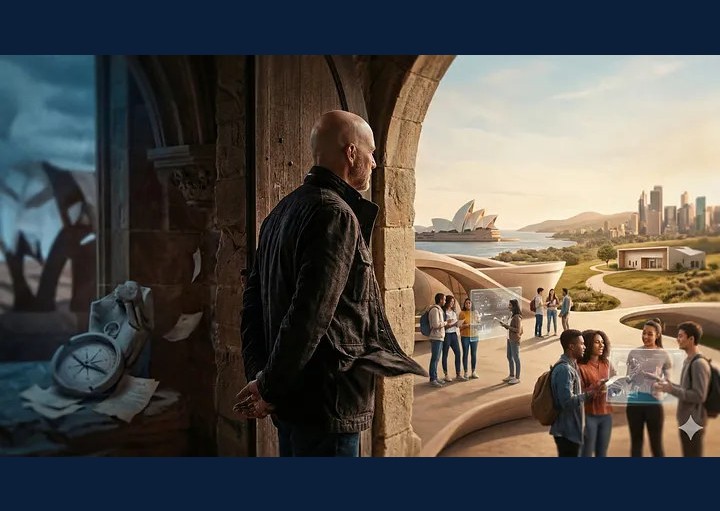
A rented RSL hall — the kind normally used for bingo nights and community raffles. Fluorescent lights humming overhead. Stale carpet. Instant coffee.
And fifteen people who were not, as the government paperwork described them, “unemployed.”
They were the discarded.
Victims of a recession that didn’t need to happen. An economy that had overleveraged itself into collapse. A banking system that turned a structural error into a national wound.
I stood at the front of that room — an American in Western Sydney, contracted by D.E.E.T. (the Commonwealth Department of Employment) to deliver skills training — and I knew within minutes that skills were not the problem.
It wasn’t their résumés that had collapsed.
It was their sense of meaning.
When “Entrepreneur” Wasn’t Enough
I began the way any instructor would. Talking about opportunity. Self-employment. Starting a business during a recession.
A few heads lifted. Most remained still. One man sighed — a quiet sound of surrender that hit me harder than any challenge could.
And then something shifted.
I had spent years studying the evolution of societies — Agricultural → Industrial → Information → Knowledge — and sensing a fifth stage forming beneath the surface. Years of spiritual study: Silva, visualization, meditation, intuition. Years of feeling the gap between what people were taught and what their souls were longing for.
In that ordinary room in Western Sydney, it all crystallized.
Not as a thought. As a birth.
“Entrepreneur isn’t enough,” I heard myself think.
I paused mid-sentence.
“No…” I said quietly, more to myself than the room.
“You don’t just need to be an entrepreneur.”
The participants stirred. A few lifted their heads. Something electric passed through the silence.
“You have to go beyond competition. You have to learn to create — not just react. Not just survive. Create.”
And then, without planning it — without ever having spoken the word before — I gave voice to what I now believe is the next evolution of human work:
“You have to become… a Creatrepreneur.”
Some laughed. Some murmured. One woman raised an eyebrow.
But I smiled — because I felt the truth of it vibrate through the room, through me, through the world itself.
A new identity had just been named.
What the Word Actually Meant
A Creatrepreneur is not simply an entrepreneur who is creative.
The distinction matters.
An entrepreneur competes. A Creatrepreneur creates — not just products or services, but value, meaning, and futures that don’t yet exist.
In that room, I was watching something Viktor Frankl had described decades earlier: when a person finds a why, they will endure any how.
The government’s success benchmark for skills programs at the time was 15% — fifteen percent of participants eventually finding work after cycling through training.
Meaning-based identity work — Creatrepreneur identity work — produced outcomes above 80%.
Not because I taught better skills.
Because meaning reactivated their will.
When meaning collapses, motivation collapses. When identity collapses, possibility collapses. But when identity re-ignites — even slightly — the entire trajectory of a life can shift.
The First Creatrepreneurs in the World
At the end of that first day, I asked everyone to stand.
Some resisted. Some sighed. Some rolled their eyes with the exhaustion of long-term unemployment.
But they stood.
“Repeat after me,” I said — not with authority, but with invitation.
“We… are Creatrepreneurs.”
A few chuckles bubbled up — skeptical, disbelieving, almost embarrassed.
But something in the room had shifted.
By the second week, their voices grew stronger. By the third, they were going home and telling their families: “There’s this Yank teaching us how to be Creatrepreneurs.”
Some families laughed. Some didn’t understand.
But within weeks, the laughter stopped. The skepticism dissolved. Identity took root.
And those fifteen individuals — people society had written off — became the first Creatrepreneurs in the world.
Long before business schools recognized what was coming. Long before conscious leadership entered corporate vocabulary. Long before entrepreneurship evolved into creation.
This was the birth of a movement, quietly unfolding in community halls across Australia. Not through capital. Not through technology. Not through credentials.
Through identity, meaning, and human spirit.
The Pattern I Had Been Tracking for Years
Societies change when their central form of value creation changes:
- Agricultural Society → humans mastered physical labor
- Industrial Society → humans mastered machines
- Information Society → humans mastered data
- Knowledge Society → humans mastered learning
But something was breaking through the surface in the early 1990s.
Knowledge was no longer enough. Information was overwhelming people instead of empowering them. Technology accelerated faster than human identity could adapt.
Beneath all of it, one quiet truth kept rising in me:
People needed to become creators of value — not merely consumers, not merely workers, not merely knowledge holders.
Value was shifting:
Data → Meaning. Products → Purpose. Skills → Identity. Labor → Creativity. Competition → Contribution.
This was not speculation. It was evolution.
The Creatrepreneur wasn’t a clever term I invented in a marketing meeting.
It was a future calling itself into the present.
What I Saw Before Others Did
Standing in that RSL hall, I recognized a quiet truth long before the world did:
People were not losing jobs. People were losing identities.
The Industrial promise was collapsing. The Knowledge Society was cresting. Technology was beginning to outrun the human frameworks designed to carry it.
And the future? The future did not belong to workers, or managers, or even traditional entrepreneurs.
It belonged to creators.
Creators of value. Creators of meaning. Creators of solutions. Creators of futures that didn’t exist yet.
What I witnessed in that small room in Western Sydney was not isolated. It was the convergence of a collapsing economic paradigm, an expiring identity model, and a new societal evolution emerging — one built on:
- Purpose as productivity
- Meaning as momentum
- Identity as capability
- Creativity as currency
- Consciousness as infrastructure
The Creation Society was not an idea I invented.
It was a pattern revealing itself. I simply recognized it early.
The Lesson That Still Applies Today
Three decades later, the forces that filled that RSL hall are playing out on a global scale.
AI is displacing workers. Automation is restructuring industries. The old promises of job security are evaporating faster than ever before.
And the response from institutions? More skills training. More credentials. More résumé optimization.
The same mistake. Different century.
What people need now is exactly what those fifteen Australians needed in 1992:
A new identity to stand on.
Not just new tools. Not just new platforms. A new self-concept — one built around the capacity to create, to contribute, and to generate value in ways the economy hasn’t even named yet.
That is what a Creatrepreneur is.
And that is why the Creation Society — the community I’ve spent over thirty years building — exists.
The world doesn’t have a skills deficit.
It has a meaning deficit.
And the answer has been the same since the first word was spoken in that RSL hall in Australia:
Create.
If this resonates, start here: thecreatrepreneur.com/start