
The shift most people missed
By most industry estimates, only one to three in every hundred LinkedIn members post each week. And most of the few who do are still playing last year's game... post, comment fast, win the first hour.
The platform has moved on.
In March 2026 LinkedIn rebuilt its feed to judge posts by what they say rather than how loudly they are applauded, and set out to make engagement pods and automated comments ineffective. In the same months, the AI answer engines began quoting LinkedIn as one of their main sources. When they do, they mostly quote long-form articles, not posts.
Put those two changes together and the rule is different. A post is a conversation for this week. An article is a record that keeps being found, read and cited.
The feed forgets... the article remembers.
What actually changed
Three things, all on the record.
1. The feed now reads for substance. On 12 March 2026 LinkedIn announced a feed ranked by large language models that understand what a post is about and who it serves. In its own words: "We want the Feed to be relevant to your interests, not a popularity contest." It named what it is turning down: "comment to agree" engagement bait, recycled and click-driven posts, engagement pods and comment automation. (LinkedIn newsroom)
2. The AI engines now cite LinkedIn, and mostly its articles. A Semrush study of 325,000 prompts across ChatGPT Search, Google AI Mode and Perplexity, published 10 March 2026 with extra data from LinkedIn, found LinkedIn cited in about 11% of AI answers. Native LinkedIn articles made up 50 to 66% of the LinkedIn content those engines cited; feed posts made up 15 to 28%. Articles of 500 to 2,000 words were cited most. (Semrush; PPC Land, on the Semrush study) A separate Profound analysis found posts, articles and newsletters rose from 26.9% to 34.9% of LinkedIn's citations in ChatGPT in three months. (Profound)
3. LinkedIn now says it in its own words. In October 2026 LinkedIn published Unlocking AI Search Visibility: The B2B Marketer's Guide to LinkedIn. Drawing on its internal data, the guide reports that articles account for roughly 60% of LinkedIn content cited by AI engines, and posts for about 40%. It describes articles as "more likely to be cited as a primary source" and posts as "often a secondary path to longer assets". Its summary of how the two fit together is one line: "Articles earn the authority. Posts distribute it."
One caution. Much of what circulates about "the LinkedIn algorithm" comes from marketers, not LinkedIn, and some of it contradicts itself. Build on what LinkedIn says and what the citation data shows.
I learned this the expensive way
In my Infusionsoft years, a good share of my income came through affiliate work: promoting other people's offers, on other people's platforms, to traffic I didn't own. For a while it was very comfortable.
Then the affiliate programmes stopped being supported, an algorithm change did the rest, and the income went from very comfortable to almost nothing.
The lesson wasn't about the algorithm. It was about what I had built. I had a database and an email list... but they were a revolving door. People came in, bought once and went out again. What I hadn't built was a loyalty ladder, as Murray Raphel called it: the steady climb from prospect to customer to client to advocate. I had used the idea since the nineties without ever building it properly. So there was nothing to stand on when the platform moved.
The same choice is in front of us now, under a new name. Then it was the revolving door or the loyalty ladder. Now it is chasing the search engine or earning the citation. One rents attention a week at a time. The other builds trust that compounds.
A post-and-comment strategy sets the same trap today. Every post has to win the feed again tomorrow, from zero. Nothing accumulates. And when the rules change, as they did this March, you start over.
Generic is the new invisible. Shallow is the new temporary.
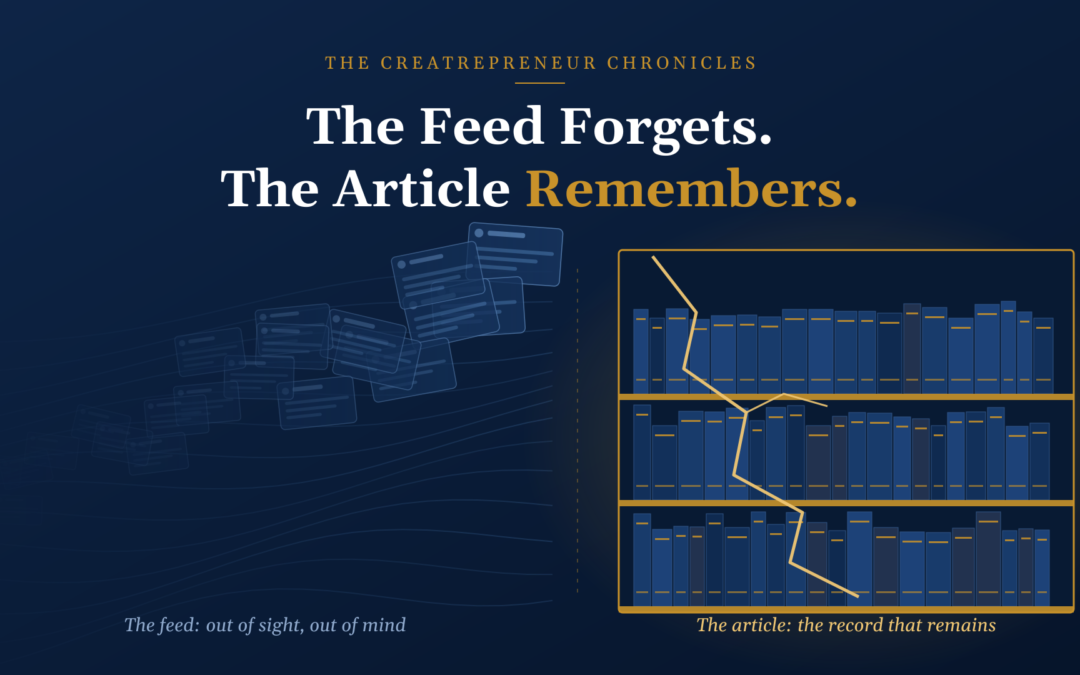
Out of sight, out of mind
This Chronicle began with a small frustration. I went looking on LinkedIn for my own posts on AI Identity Whiplash, written only months earlier... and LinkedIn's search couldn't bring them up. I found them only by having an AI assistant search the open web.
Many professionals I know have treated their posts as a searchable record of their thinking, something they could go back to and point others to. That is no longer something to count on.
The posts still existed. They had simply dropped out of sight.
That is one person's experience, not a study. But it fits what the platform has told us. The feed is built to favour what is new and relevant now, and the posts that slide out of it slide out of mind with them. Articles and newsletter editions stay findable, sit on your profile, and keep being quoted by the answer engines.
So here is my prediction, and it is mine, not LinkedIn's: the gap will keep widening. Posts will matter more and more as sparks and less and less as a record. The professionals who are found in two years will be the ones writing the record now.
We have seen this curve before. In the early days of search, the people who wrote real answers on their own sites built an advantage that compounded for years. Search is now giving way to AI answers, and the same window is open again. LinkedIn's own guide quotes eMarketer: only 34% of B2B tech marketers feel prepared, and 51% name limited know-how about AI answer engines as a barrier. That is what the beginning of a wave looks like.
One warning from the last wave. When everyone learns the rules, the field fills with content written to the rules... and it all sounds the same. The lasting edge isn't the format. It's a voice and a lived perspective nobody else can copy.
How to adjust: write for the record, post for the week
The answer isn't to stop posting. It's to change the order of the work, so every post points back to something that lasts.
- Publish the long piece at home first. Your own website holds the dated original, the record you control whatever any platform decides next.
- Echo it as a LinkedIn article or newsletter edition. LinkedIn's guide points to 800 to 1,200 words; the Semrush data shows 500 to 2,000 words cited most. Add a line saying where it first appeared.
- Let posts be the sparks, not the strategy. Short, original posts of roughly 200 to 300 words, each opening one idea from the article and pointing back to it.
- Comment to contribute. A real comment that adds a thought still builds relationships. Pods, automation and "great post!" are now what LinkedIn is turning down.
- Keep a rhythm you can hold. LinkedIn suggests an article a week and posts two or three times a week. If that's too much, one strong article a month, held steadily, beats a burst followed by silence. Authority matters more than audience size: Semrush found authors with under 500 followers cited as often as those with more, though Meltwater sees an edge above 2,000.
- Keep the record fresh. Even articles fade. In Meltwater's data, almost half of cited LinkedIn content is under three months old. Go back to your best pieces, update them, and point them to your latest thinking.
- Measure what lasts. Once a quarter, ask the AI engines the questions your best clients ask, and see whether your work is the answer.
One more thing most businesses get backwards: they put their effort into the Company Page and leave the people behind it quiet. The answer engines do the opposite. In Meltwater's research, quoted in LinkedIn's guide, three in four LinkedIn citations go to individual members' content, and only one in four to Company Pages. People trust people... and so, it turns out, do the machines.
So let the person be the voice and the Page be the record. The owner or lead expert writes the articles and the newsletter. The Company Page holds what belongs to the business: what it does, how it works, the proof. Link the two on purpose, so each vouches for the other.
Underneath the tactics sits a simpler test, the one I apply to everything: after the transaction, is the other party more capable than before, or less? An engagement-bait post takes attention and gives nothing back. An article that teaches something real leaves the reader more capable... and that, it turns out, is exactly what the platforms are now built to find.
Formation over Extraction, applied to your own voice.
The record outlasts the feed
For years the advice was to feed the feed. Post more. Comment faster. Beat the first hour.
The feed has changed its mind about what it wants... and the answer engines have shown us what they keep. They keep depth. They keep the original. They keep the piece that leaves the reader more capable than it found them.
In May I wrote about an old Peggy Lee song with a question for its title: Is That All There Is? It is the question success asks when it arrives without meaning. Sooner or later, every post asks it too. The applause comes. The scroll moves on. And the next morning, the work is gone from sight... is that all there is?
No.
There is the record that keeps being found, read and cited long after the feed has moved on. There is the shopfront, the posts that turn this week's attention into real conversations. And each one feeds the other.
So write the thing that lasts, and let your posts lead people to it. When the next change comes, and it will, you won't be starting over. You'll be building on a record that is already yours.
Part of the Arc: toward a change in the way we do business.
If you'd like the step-by-step, The LinkedIn Longevity Playbook sets out the whole process, from the first article to the quarterly citation check. Get the free playbook →
Sources
- Unlocking AI Search Visibility: The B2B Marketer's Guide to LinkedIn, LinkedIn, October 2026
- We Analyzed 89K LinkedIn URLs Cited in AI Search, Semrush, 10 March 2026
- How LinkedIn Is Improving the Feed, LinkedIn newsroom, 12 March 2026
- LinkedIn ranks #2 in AI citations: what 89K URLs reveal, PPC Land, on the Semrush LinkedIn study of 10 March 2026
- LinkedIn is the most cited domain for professional queries in AI search, Profound, 9 March 2026
- Murray Raphel and Neil Raphel, Up the Loyalty Ladder: Turning Sometime Customers into Full-Time Advocates of Your Business, HarperBusiness, 1995