

When the Survival Gap and the Appreciation Deficit meet, responsibility lands on the people with the least left to carry it.
The Creatrepreneur Chronicles — by Kevin J. Barrett
Nov 7, 2026
For two years I've been asking the wrong question about my own business.
The question was: why aren't more people saying yes?
The better question turned out to be: whose job is it to close the gap?
Two years of nowhere to put a yes
In August 2024 I left school coaching and teaching and returned full time to my consulting practice. Since then I've built a website, written these Chronicles, designed a ladder of offers and given away free tools. The traffic stayed low. The search for paying customers went on longer than any plan said it would.
Last month I sent a free gift, the STOP Technique, to about 700 athletic directors. Some of them know me personally. Several told me they'd received it. Most still hadn't downloaded it.
They didn't say no. They simply had nowhere to put a yes.
If you're one of those people, you know what that feels like from the inside. The email you meant to answer. The thing that would help, saved for later... and later never comes. The quiet guilt at the end of the day, because you said yes again to someone else and no, again, to yourself.
It isn't a character flaw. It isn't laziness, and it isn't a lack of caring. Usually it's the opposite: the people who care most are the ones with the least left. If that's you, the first thing to know is that the gap isn't your fault. The second is that it can be closed.
I called that the Survival Gap: the distance between what people know would help them and the time they have to reach for it. Its twin is the Appreciation Deficit, the way we under-value the people who hold everything together, written in their pay, their workload and their morale.
Then, on a morning when I took a shorter walk instead of a longer run, sat for a short meditation and went back to work, a question arrived that I couldn't put down.
What happens when those two gaps meet responsibility?
The Responsibility Gap
Here is my answer.
The Responsibility Gap is the distance between what people are expected to carry and the time, support, authority and recognition they have to carry it well.
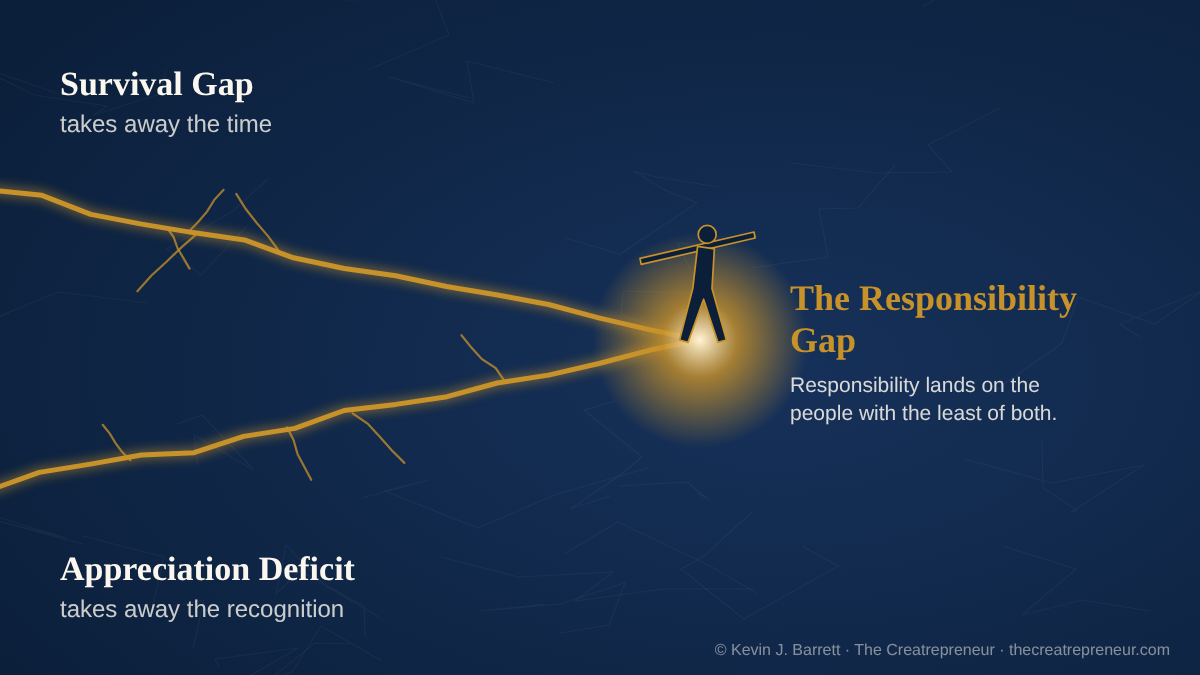
It forms where the other two meet. The Survival Gap takes away the time. The Appreciation Deficit takes away the recognition. And then responsibility arrives anyway... and it lands hardest on the people with the least of both.
That's the cruel part. The most committed people already have the widest Survival Gap, because they give the most. So when more responsibility comes down the line, it doesn't flow to the person with the most room. It flows to the person who has never said no.
The philosopher Andreas Matthias used the phrase "responsibility gap" in 2004 for a different problem: who is to blame when a learning machine acts on its own. That question is getting louder as AI takes on more work. My extension is to people. Most organisations haven't solved the responsibility gap for their humans, and they're about to hand more of it to machines.
Ilya Prigogine showed how a system pushed far from balance reaches a bifurcation point, where one path splits into many. What I see here runs the other way, a reverse bifurcation point: two separate pressures converge on one place. That place is responsibility.
Do it once, you are gold
I learned the first half of this at 3M.
3M allowed employees a share of their working time, 15% then, for their own projects. I used that time to develop new products. It was the best design for creativity I've ever worked inside... and it had a catch.
Your direct supervisor could come to see that 15% as time he couldn't control.
Do it once, you are gold. Do it three times and you become uncontrollable.
An old friend at 3M put it to me plainly: "Kevin, you have a problem. When you care more about the company than the company cares about itself."
That's the Responsibility Gap from the inside. The company asked people to take initiative, then hadn't made room for what happens when they do.
The people stayed. The process changed.
The second half I learned earlier, on a factory floor in Rochester, New York.
In 1969 I became Quality Assurance Supervisor at 3M's Rochester plant, and we rebuilt two product lines from the statistics up. In under two years, customer complaints fell from over 300 per ten thousand square feet to 0.05. Manufacturing write-offs fell from $250,000 a year to under $20,000.
Nobody was replaced. Nobody was retrained. We changed the process.
Most failure lives in the system, not in the person standing in front of you. I have never found an exception: not in a factory, not in a classroom, not anywhere.
So when someone "isn't taking responsibility," the first question isn't about their character. It's about the design they're working inside.
Designing responsibility in
In the 1990s Westpac hired me to help set up its Mortgage Processing Centre in Adelaide. Together with the union, we divided the mortgage process into eight sections. Each employee chose the three trainings they wanted next. We scheduled training around production, so learning never fought the work. Every completed section came with a pay increase.
That's what closing the Responsibility Gap looks like. People were asked to carry more, and they were given the time to learn it, the choice of what came next and recognition they could see in their pay.
I could have stayed on a three-year contract. I asked Westpac to give the work to someone inside instead, so the bank would own it. That was my side of the responsibility: leave them able to carry it without me.
Back to my own two years
Which brings me back to the question I started with.
The athletic director with games every night is inside both gaps. So is the small-business owner who is the one doing everything on the list. I'd been asking them to cross the gap to reach me: read this, download that, book a call.
They couldn't. They had nowhere to put it.
When two gaps meet, someone has to take responsibility for closing them. The person inside both can't. So it falls to whoever designs the conditions: the leader, the system builder... the founder.
I wrote years ago that if someone doesn't understand what I'm trying to convey, it's not their fault. It's mine. The same is true here. If good people can't reach what would help them, the first responsibility is mine.
Responsibility starts in the mirror.
Expertise isn't arriving with the answer. No two situations are the same. It's being able to find the right one for this situation... including your own.
So I've changed the order. Give time back first. Hand over something that works before asking for anything. Make the first step so small it fits inside a day that's already full.
Three questions before one more thing
Before you ask anyone, an employee, a volunteer, a teacher, yourself, to take on one more responsibility, ask:
- What will I remove so there's room for it?
- What will I provide: time, training, authority, support?
- How will I recognise it, in a way they can actually see?
If you can't answer all three, you haven't handed over a responsibility. You've handed over a weight.
There's one more thing about gaps.
Creativity forms in the gaps.
Every writer knows the block. Every artist knows the blank canvas. And when a block is finally uncovered, it often holds the best answer of all... the creation that was waiting underneath. The Responsibility Gap works the same way. Once you can see it, it shows you where the better design is. And when you close it, what's left isn't empty time. It's Creation Margin: room for the person who cares most to create.
Caring more than the system around you does isn't a problem to cure. It's a signal. It tells you where the gap is... and who's ready to help close it.
If you're the owner carrying the whole list, start here, and we'll find the first thing to take off it: thecreatrepreneur.com/start
Sources
Borrowed, and credited
- Andreas Matthias, "The responsibility gap: Ascribing responsibility for the actions of learning automata", Ethics and Information Technology 6, no. 3 (2004): 175–183. The origin of the term in machine ethics; this Chronicle extends it to people and organisations.
- Ilya Prigogine and Isabelle Stengers, Order Out of Chaos (Bantam, 1984). Bifurcation points in systems far from equilibrium; the "reverse bifurcation point" is my extension.
- W. Edwards Deming, Out of the Crisis (MIT Press, 1986). The system, not the worker, as the main source of variation.
My own record
- The Survival Gap, The Creatrepreneur Chronicles, 26 October 2026
- The Appreciation Deficit, The Creatrepreneur Chronicles
- The record: dated roles at 3M (1966–1987), including the Rochester quality results, and the Australian engagements
- The Lexicon: Survival Gap, Appreciation Deficit, Creation Margin, and from today the Responsibility Gap