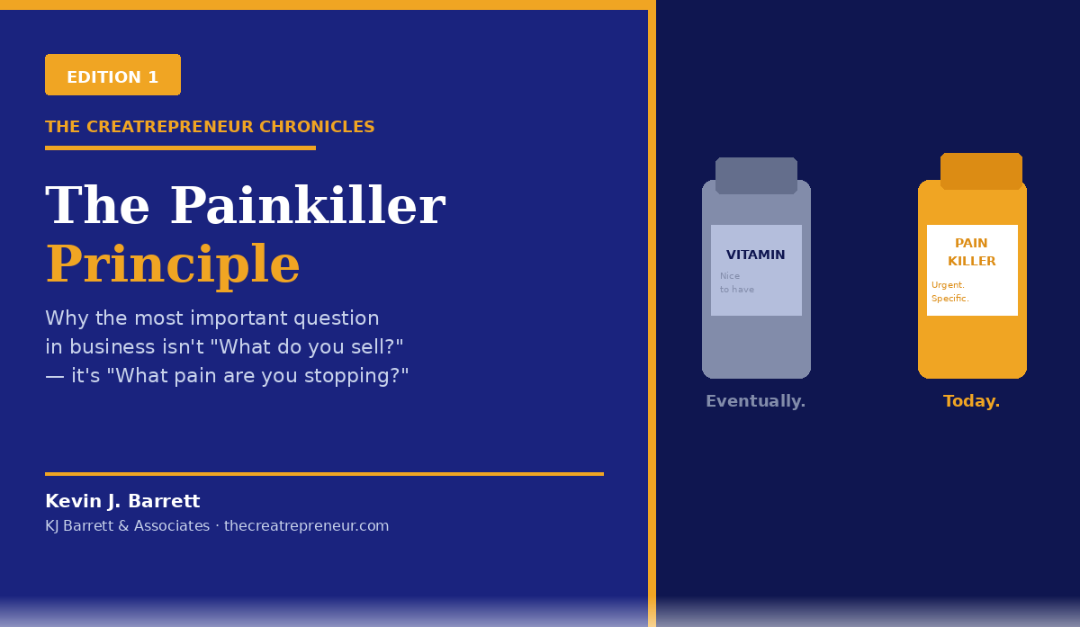
Why the most important question in business isn't "What do you sell?" — it's "What pain are you stopping?"
The Creatrepreneur Chronicles — by Kevin J. Barrett
Originally posted on LinkedIn on May 15, 2026.
Welcome to The Creatrepreneur Chronicles.
This is Edition 1 of a newsletter built on a simple promise: that philosophical depth and operational rigor are not opposing forces, and that the people who succeed long-term in business have figured out how to integrate both.
If you've followed my work — the Missing Link article, the SOULutions framework, the Best for All Concerned Compass — you already know my position. Today I want to introduce the practical edge of it.
A principle I learned from a creator commerce training video. It applies to every business I've consulted on since 1993. It applies to your business. And it almost certainly applies to a platform or product you're invested in right now.
I call it The Painkiller Principle.
The Distinction That Changes Everything
The team at Stan Store uses a simple framing to describe the difference between products that succeed and products that don't:
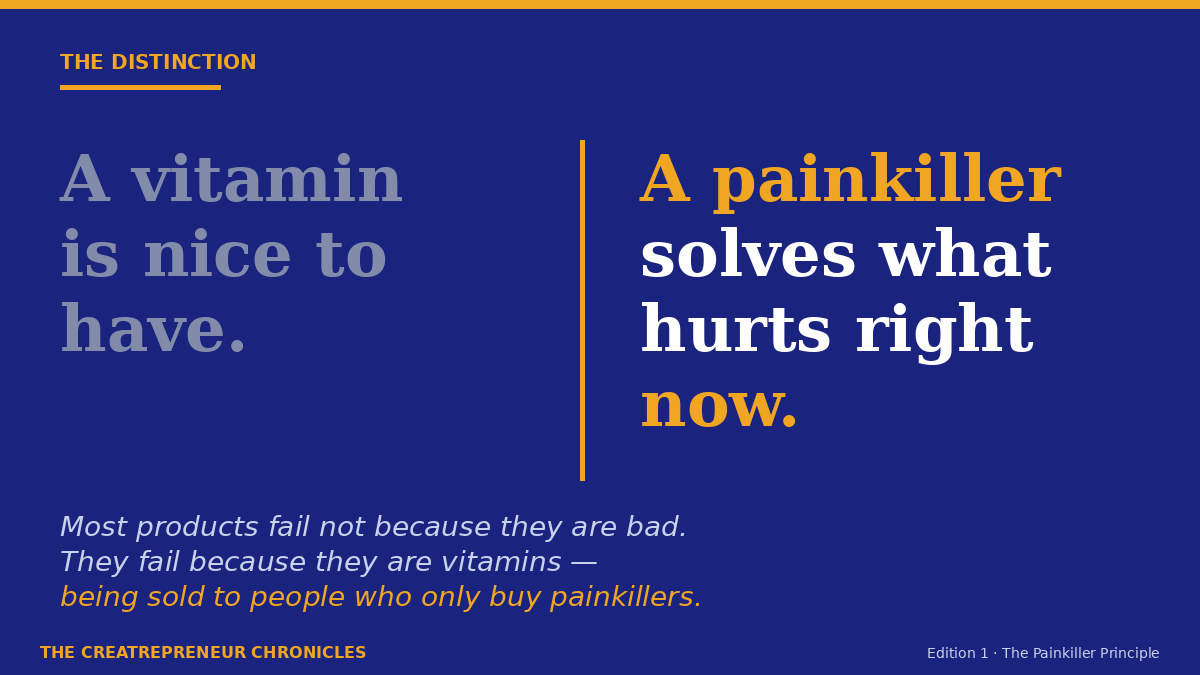
A painkiller product solves an urgent problem that customers desperately need fixed.
A vitamin product is nice to have.
The difference is not in the quality of the product. The difference is in the urgency of the problem it addresses.
Consider:
VITAMIN: "I should probably eat healthier."
PAINKILLER: "I have a job interview Monday and my suit doesn't fit."
VITAMIN: "I should learn more about marketing."
PAINKILLER: "I launched my product and nothing is selling. I need help today."
VITAMIN: "My homeschool student should think about college eventually."
PAINKILLER: "My son is a junior, has no transcript, and applications open in six months."
Most products fail not because they are bad. They fail because they are vitamins being sold to people who only buy painkillers when something hurts.
And the more profound version of this insight: most platforms suffer from the same mistake. They build something useful — even genuinely valuable — but they position it as a vitamin. They describe what it does. They list its features. They explain its philosophy. They never name the pain it stops.
Specificity Sells. Generality Whispers.
The second principle the Stan team names is one Creatrepreneurs understand instinctively but often forget when building their own marketing: specificity sells.
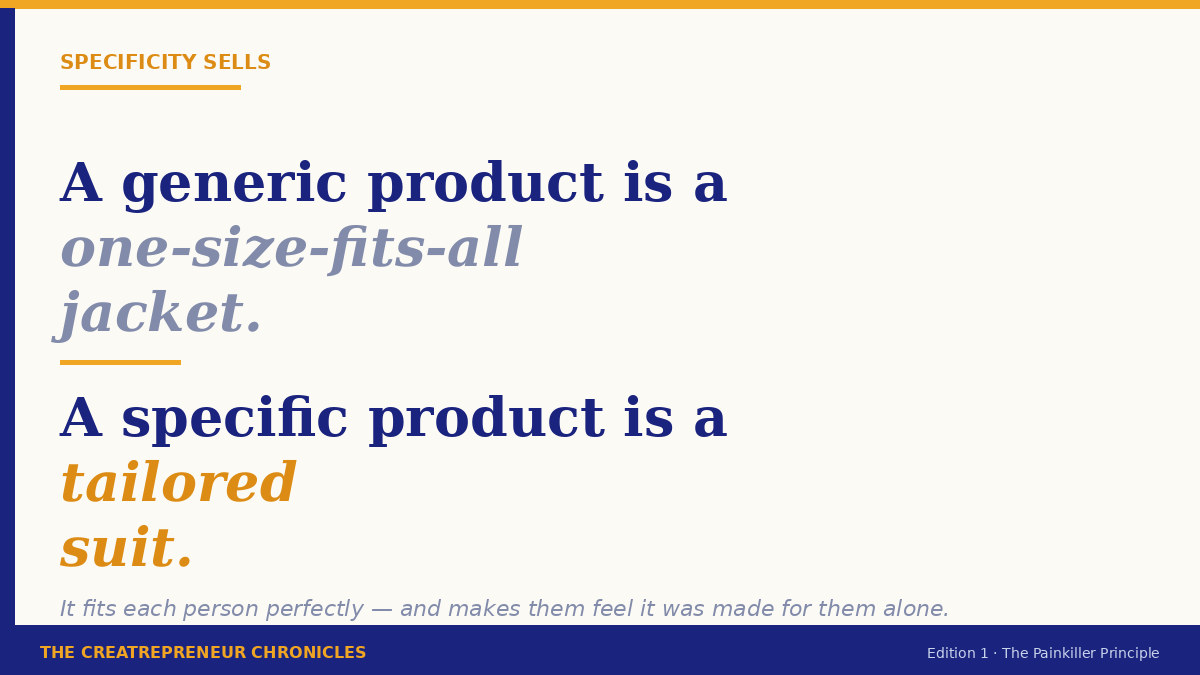
They use a metaphor I will paraphrase: a generic product is like a one-size-fits-all jacket. It might fit everyone, but it does not fit anyone well. A specific product is like a tailored suit. It fits each person perfectly and makes the wearer feel like it was made for them alone.
A platform that says "We help students with college prep" is the one-size-fits-all jacket. It might serve everyone in theory. It serves no one specifically. The homeschool parent in North Carolina with three kids and no school counselor does not see herself in that message. She walks past it.
A platform that says "We help homeschool families build NCAA-compliant transcripts that actually get reviewed by Division I coaches" is the tailored suit. The person who needs it cannot walk past it. Because it speaks to her exact situation in her exact language.
This is not a copywriting trick. This is the difference between a product positioned as a vitamin and the same product positioned as a painkiller for a specific person at a specific moment in a specific circumstance.
The $0 Test — And Why Most Platforms Skip It
The Stan training describes something called the $0 Test Method. The principle is simple: validate that anyone actually wants what you are building before you build it.
- Poll your audience
- Launch a free scaled-down version
- Soft-launch with pre-orders
- Build a waitlist
I have lived this principle since 1993, across multiple industries on four continents. It is not a digital product strategy. It is an ethical business principle. You do not assume you know what people need. You ask them. Then you build the smallest possible thing that proves they will use it.
What most platforms — particularly funded startups — do instead: they build the maximum version of what they think users should want, then look at low engagement numbers six months later and wonder what went wrong.
The pattern I have seen repeatedly:
- Months spent building features users did not ask for
- A launch designed around the platform's vision rather than the user's pain
- Generic positioning that does not speak to any specific user
- Content marketing without capture infrastructure
- Visible signs of activity without measurable conversion
- A growing question in the marketing team: "Where are the users?"
None of these are platform problems. All of them are sequencing problems.
The Give-Give-Ask Method
Here is where the Stan philosophy and the Creatrepreneur framework converge most clearly.
The Stan team calls it the Give-Give-Ask method. I have called it Best for All Concerned since 1993. The principle is the same: serve first, ask second.
Their metaphor: tending a garden. You water the soil. You nourish the plants. You let them flourish. Then you harvest the fruits. If you try to harvest before the garden produces, you have nothing. If you try to sell before you have served, your audience has no reason to buy.
This is not marketing strategy. This is a values framework expressed through marketing. The platforms and creators who break through are not the ones who manipulate harder. They are the ones who give more, give again, and only then make a request that the audience is genuinely positioned to receive.
Every Chronicles article I publish operates on this principle. Every free resource. Every comment, every reply, every walkthrough I record for free. The audience that bought the Foundations Workbook this week did so because they trusted me before I asked them to.
The Three Pieces of Conversion Infrastructure
Once you have positioned your product correctly — painkiller, specific, validated, given freely first — the Stan team identifies three concrete elements every sales page needs:
One: A hook that names the problem. Not a clever headline. A statement that makes the right person feel seen the moment they read it. If your hook does not stop the right person mid-scroll, the rest of the page does not matter.
Two: A clear explanation of how the product solves the problem. Not a list of features. A concrete description of what the user gets — and what changes for them as a result. Features describe the product. Outcomes describe the user's new reality.
Three: Credibility that the right person can verify. Not credentials in the abstract. Specific evidence — testimonials, case studies, documented results — that the right person can connect to their own situation.
Three elements. Universally applicable. Almost universally missing from the marketing pages of platforms — including platforms with genuinely good products.
What This Means for the Creatrepreneur
If you are building anything — a course, a coaching practice, a SaaS platform, a consulting firm, a nonprofit, a book — these principles apply to you.
Name the pain before you name the product. What is the urgent problem your work addresses for a specific person at a specific moment? If you cannot answer that in one sentence, your positioning needs work — not your product.
Choose specificity over reach. A specific message to a specific audience converts higher than a generic message to a broad one. The market does not reward universal appeal. The market rewards perfect fit.
Validate before you build. Ask before you assume. Test before you invest. The $0 method protects you from building things no one wants — and reveals opportunities you did not see.
Give before you ask. Best for All Concerned starts with what you give freely. Trust precedes transaction. Always.
Build the three pieces of conversion infrastructure. Hook. Outcome. Credibility. Anything missing one of these underperforms regardless of how good the product is.
The Honest Closing
I have been observing — across many industries, many companies, many launches — that the principles I named in this article are almost never absent from the products and platforms that succeed, and almost always partially missing from the ones that struggle.
This is not a sophisticated insight. The Stan team teaches it in a twenty-minute training video to creators starting their first digital product. The principles are not hidden. They are simply skipped — by people who assume they already know what their audience needs, by platforms that prioritize their internal vision over external validation, by founders who do not stop to ask the question that matters most:
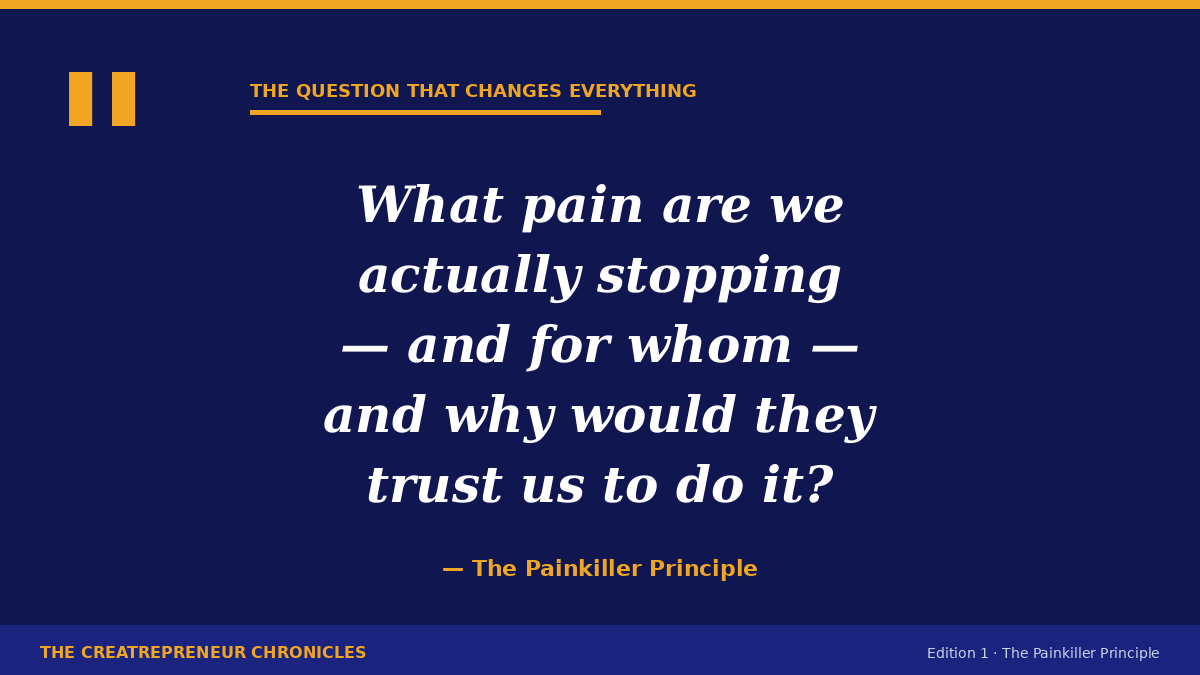
"What pain are we actually stopping — and for whom — and why would they trust us to do it?"
Every product on my Stan Store this week answers that question. Every Chronicles article. Every workflow I have built. Every email in my homeschool nurture sequence. Every recommendation in the GHL affiliate program.
Because if the answer to that question is unclear, the rest of the marketing does not matter.
And if the answer is clear, the marketing almost takes care of itself.
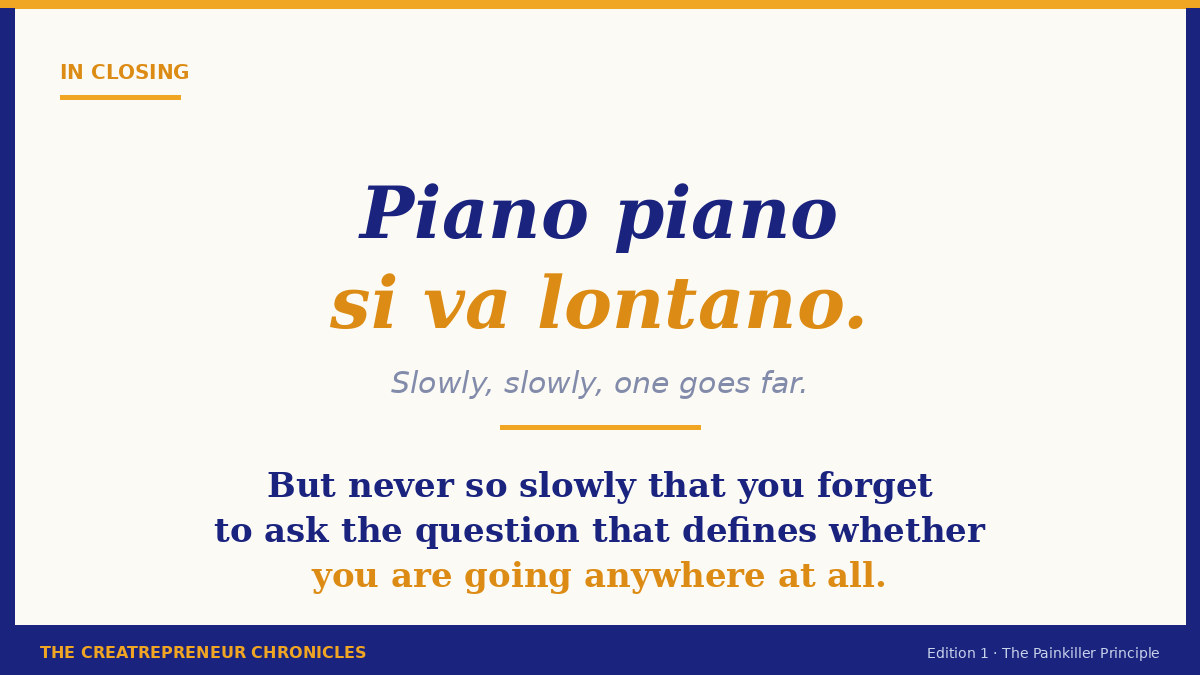
Piano piano si va lontano. Slowly, slowly, one goes far.
But never so slowly that you forget to ask the question that defines whether you are going anywhere at all.
Continue The Journey
If this resonates, start here: thecreatrepreneur.com/start
Kevin J. Barrett is a Global Business Consultant, Author of "The Rise of the Creatrepreneur," and Founder of The Creatrepreneur movement. With international business experience across four continents since 1993 — trained directly under Dr. W. Edwards Deming when at 3M — Kevin helps entrepreneurs build businesses that honor what matters most.
The Creatrepreneur Chronicles is published from KJ Barrett & Associates · Zephyrhills, Florida · © 2026 All Rights Reserved.