Noah Hawley's reflection on billionaire detachment points to a deeper crisis of our age: the erosion of consequence, empathy, and responsibility in a frictionless world — and the need for a Human North Star.
The Creatrepreneur Chronicles — by Kevin J. Barrett
Originally posted on LinkedIn on April 23, 2026.
Noah Hawley's April 20, 2026 Atlantic article, What I Learned About Billionaires at Jeff Bezos's Private Retreat, is about more than one weekend, one billionaire, or one private gathering. Recounting his family's experience at Bezos's 2018 "Campfire" retreat, Hawley names a condition that may be one of the defining moral dangers of our time: a world in which extreme power and wealth detach people from consequence, until everything becomes effectively free and nothing seems to matter. That phrase stayed with me.
Because it names something I have been noticing for a very long time.
We are surrounded by conversations about inequality, polarization, extremism, manipulation, and institutional distrust. We are watching economic, political, educational, religious, and spiritual fractures widen in real time. At the same time, we are entering an era of AI acceleration that is not only disrupting jobs and industries, but identity, cognition, and the very way human beings relate to reality.
I have called part of this AI identity whiplash.
But underneath all of it may be an even deeper issue:
the erosion of consequence.
The Human Need for Consequence
When we raise children, one of the first truths we try to teach is simple: actions have consequences.
Not because consequences are cruel. Because consequences are formative.
They teach us that other people are real. They teach us that choices matter. They teach us that freedom and responsibility are inseparable.
That is why I have come to believe that freedom and responsibility are almost a direct equation.
The more freedom we have, the more responsibility we have.
Money, success, and freedom can create opportunity. More choices can open doors. More resources can create greater possibility. In themselves, these are not bad things. Wealth is not automatically corruption. Success is not automatically moral decay.
But something changes when a person, a company, a government or a class of people becomes so insulated from friction that consequence no longer teaches.
That is the warning inside Hawley's reflection.
His argument is not simply that billionaires have too much. It is that extreme insulation can produce a loss of contact with ordinary human cause and effect. In his telling, when nothing can meaningfully be lost, failure itself becomes abstract, and empathy begins to fade (The Atlantic). The Atlantic article by Noah Hawley gives a profound insight.
Because once consequence disappears, humanity can begin to disappear with it.
When Success Becomes Frictionless
We often speak of freedom as though it is the highest good.
But freedom severed from responsibility becomes dangerous.
When everything is optimized for convenience, comfort, insulation, and control, we can gradually lose the friction that keeps us honest, grounded, and relational. We may still speak the language of values. We may still perform concern. We may still talk about changing the world.
But if we are no longer touched by consequence, then our words float above reality.
And that is not only a billionaire problem.
It is becoming a cultural problem.
In many corners of modern life, we are incentivized to avoid reflection, bypass depth, and consume stimulation in place of meaning. We scroll rather than study. We react rather than contemplate. We perform rather than integrate.
The result is not merely distraction.
It is a weakening of cognitive agency.
AI Changes the Scale
Now bring AI into this equation.
AI is not conscious in the human sense, but it is an amplifier of human intention, pattern, speed, and scale. It can help us learn faster, create faster, analyze better, and expand opportunity in ways that were impossible only a few years ago.
That is the opportunity.
The risk is that it can also amplify disconnection.
It can multiply noise. It can accelerate manipulation. It can deepen dependence. It can centralize power in the hands of those who already have extraordinary leverage.
That is why the human link matters so much.
The tool is not the conscience.
We are.
In the metaphor we have discussed before, we are the corpus callosum. We are the link between power and wisdom, between capability and conscience, between raw intelligence and integrated humanity.
That is why intention matters.
And that is why responsibility matters even more in the AI age, not less.
The Need for a North Star
This is where I believe Hawley's article becomes more than cultural commentary. It becomes an alert.
An early warning.
Because if we continue building a world where friction disappears for the powerful while passivity deepens for the masses, then we should not be surprised if empathy erodes at the top and agency erodes below.
That is not a stable civilization.
It is why I believe we need more than policies, prompts, or profit strategies. We need a North Star for humanity.
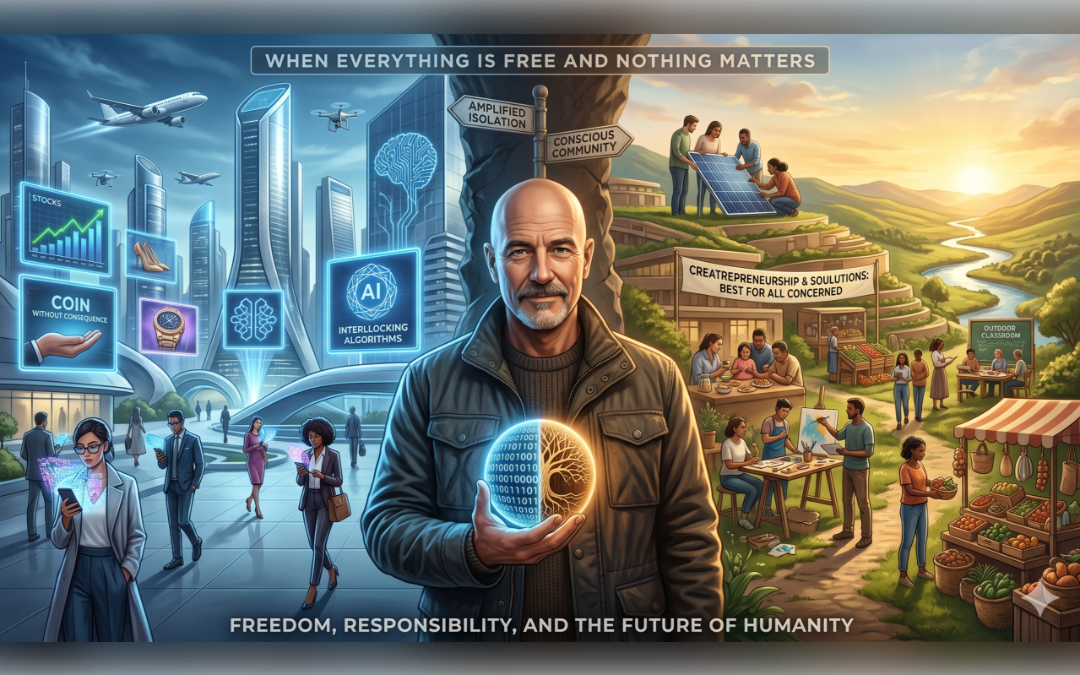
For me, that North Star is found in the integration of Best for All Concerned, Creatrepreneurship, Creation Society, and SOULutions.
Not as slogans. As operating principles.
They remind us that freedom must remain tied to responsibility. That creation should serve contribution, not extraction. That innovation should elevate human flourishing, not bypass it. That intelligence without empathy is not progress. And that power without consequence is one of the oldest dangers in history, now arriving in digital form.
A Different Possibility
There is another path.
AI does not have to become a tool of concentrated advantage alone.
It can become a force for co-elevation.
It can help ordinary people create new forms of value. It can support learning, entrepreneurship, insight, and problem-solving. It can widen participation in wealth creation rather than merely enriching platform owners. It can help build a society in which more people become creators, contributors, and conscious stewards of the future.
But none of that happens automatically.
It depends on the values we bring to the tool.
It depends on whether we remain awake.
It depends on whether we reclaim responsibility as the necessary companion of freedom.
The Question Before Us
Hawley's phrase is memorable because it captures a spiritual danger hidden inside material success:
When everything is free and nothing matters, we can lose our humanity. That meaning now belongs to all of us.
Not only billionaires. Not only tech founders. Not only political leaders.
All of us.
Because in this era, the question is no longer simply who has the most money or the most powerful tools.
The question is who still feels consequence. Who still values empathy. Who still takes responsibility for what they amplify.
And perhaps the real question of this age is this:
Will we use responsibility in service of freedom, or will we continue to scroll and slowly surrender the cognitive and moral power that makes freedom possible in the first place?
If this resonates, start here: thecreatrepreneur.com/start
Kevin J. Barrett is a Global Business Consultant, Author of "The Rise of the Creatrepreneur," and Founder of The Creatrepreneur movement. With international business experience across four continents since 1993 — trained directly under Dr. W. Edwards Deming when at 3M — Kevin helps entrepreneurs build businesses that honor what matters most.
The Creatrepreneur Chronicles is published from KJ Barrett & Associates · Zephyrhills, Florida · © 2026 All Rights Reserved.