
By Kevin Barrett · May 2026 · Edition 3 · KJ Barrett & Associates
A reader wrote back after the last edition with a question worth honoring publicly:
"Kevin — you mentioned four dimensions in Edition 2. The questions you've stopped asking. The destination you've been afraid to name. The filter you've been avoiding. The future self you've been resisting. I keep returning to these. What are the actual questions?"
That's the right question to ask.
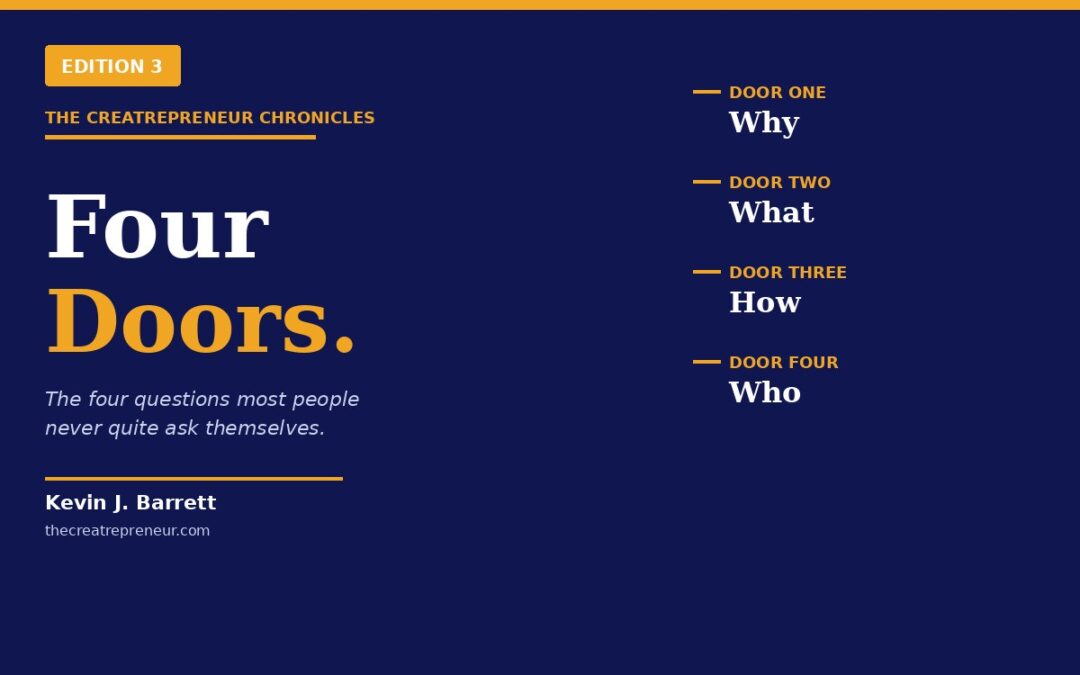
The four pillars I gestured at in the last edition aren't separate teachings. They're four doors in a single building. Each one opens onto the same room — but you can only enter through the door that matches where you are.
Today, the four doors.
Not the system that integrates them — that comes in a future edition. Just the four questions, named directly, with permission to sit with any of them as long as you need to.
Door One — Why
"What would I do with my remaining years if the outcome were guaranteed but the experience wasn't?"
This is not a goal-setting question. It's a values question dressed in goal-setting clothing.
Most of what we call "goals" are actually negotiations with fear. We want X, but only if we're sure we can get it. We want to start the business, but only if it's safe. We want to write the book, but only if it sells. We want to leave the marriage, but only if we know the next chapter will be better.
The "guaranteed outcome" part of this question isn't about success. It's about removing the fear of failure from the equation entirely — so you can finally see what you actually want.
When success is assumed, what would you choose to do?
That answer tells you what you actually value — separate from what you've been pursuing because you thought it was required.
Most people don't ask this question because the gap between the answer and their current life is too uncomfortable to face.
Sit with it anyway.
Door Two — What
"What destination would I commit to if I knew I couldn't fail?"
Door One asked what you'd choose. Door Two asks what you'd commit to. The difference matters.
Most people have hundreds of preferences and zero commitments. A commitment requires a defined destination — clear enough to be measured, audacious enough to be terrifying.
A real destination has three qualities:
1. Specific. Not "more impact" — a measurable target.
2. Audacious. Not safely within your current capability.
3. Yours. Not one your parents, mentor, or peer group would approve of — though it may overlap.
Most people choose small destinations because they're survivable. The price of small destinations is small lives.
A destination doesn't have to be ten years out. It can be three years, eighteen months, or one year. What it has to be is beyond what your current methods can produce. Otherwise it's a goal, not a destination — and goals you can already see how to achieve don't produce transformation.
The destination forces the transformation. The transformation produces the achievement. Not the other way around.
Door Three — How
"What am I doing today that wouldn't make the cut if I were honest about whether it serves my destination?"
This is the honest filter you've been avoiding.
Most people don't audit their activities because they don't want to be honest about what would have to go. The audit produces grief before it produces growth.
Look at last week. Make a list — not of what you accomplished, but of what you did. Every meeting. Every commitment. Every conversation. Every distraction. Every habit. Every decision.
Now ask of each one:
Does this serve the destination from Door Two?
Or is this something I'm doing because:
— It used to serve a destination I no longer have
— It serves someone else's destination
— It feels productive without actually being productive
— I've been doing it so long I don't question it
— It's easier than facing what would replace it
What stays on your list when you remove what doesn't serve the destination?
That is what you should be doing.
What's harder is what stays in your life that ISN'T on your list. Sometimes the most important audit isn't about adding the right activities — it's about removing the right ones.
Door Four — Who
"Who would I have to become to actually live as if my answers to the first three questions were true?"
This is the future self you've been resisting.
The resistance isn't usually about the work or the discipline. It's about the identity shift.
The version of you who would commit to that destination, apply that filter, and serve that purpose — is not the version of you reading this. That's why most people never make the change.
The new self threatens the old self.
Some of what the old self believed about you would no longer be true. Some of the relationships the old self maintained wouldn't survive. Some of the protections the old self relied on would have to be released.
No wonder most people stay where they are. The cost of becoming feels higher than the cost of remaining — even when remaining is killing them slowly.
But here's what the question is actually asking — and what almost every framework gets wrong:
The new self isn't extinguishing the old self.
The new self is releasing what no longer serves
and integrating what does.
The five-year-old you, the twelve-year-old you, the twenty-five-year-old you — they're not deleted in the becoming. They're integrated. Their gifts come forward. Their wounds get tended. Their patterns get released.
This is the work most personal development never quite addresses — and it's the work that determines whether the first three doors actually lead anywhere.
The Filter That Integrates the Four Doors
These four doors all open onto the same room.
The room is sometimes called by different names — purpose, vocation, contribution, calling. I'm not going to add to that vocabulary today.
What I want to name is the filter that integrates the four doors:
Best for All Concerned.
Without this filter, the four doors become tools of self-optimization that may produce achievement but rarely produce meaning.
Without the filter:
Why becomes self-indulgent. "My fulfillment matters most."
What becomes ego-driven. "My destination is the destination."
How becomes ruthless. "Whatever serves the goal is justified."
Who becomes manufactured. "I will become whoever produces the result."
With the filter:
Why connects to service. "My fulfillment is bound up with others'."
What connects to contribution. "My destination produces value beyond my own arrival."
How connects to integrity. "The means are part of the end."
Who connects to authentic emergence. "I become someone whose becoming serves more than self."
Service to your own becoming. Service to those in your direct sphere — family, team, clients, community. Service to the larger circles — industry, country, generation.
Service, finally, to the planet itself — which is the largest "we" most of us can hold without losing meaning.
This is what makes the four doors work. Otherwise they're just productivity questions in better clothing.
In Closing
Don't try to walk through all four doors today.
Don't journal the four questions as a checklist and feel productive for having "done the work."
Sit with which one you'd rather not look at.
That one is the door.
Whichever question is hardest to face is the one that's been waiting for you. The other three will be easier to walk through after you've passed through that one.
Future editions will explore each door more deeply.
Future editions will also introduce the integration — how the four doors function together as a single architecture, drawing from teachers I trained with directly decades ago and frameworks the contemporary world is finally catching up to.
For now, just notice.
"The question you didn't want to answer first is the one that's actually been asking you."
If this resonates, start here: thecreatrepreneur.com/start
— Kevin Barrett · LinkedIn