
What a town with no jobs taught me about the Creation Society
The Creatrepreneur Chronicles — by Kevin J. Barrett
Nov 16, 2026
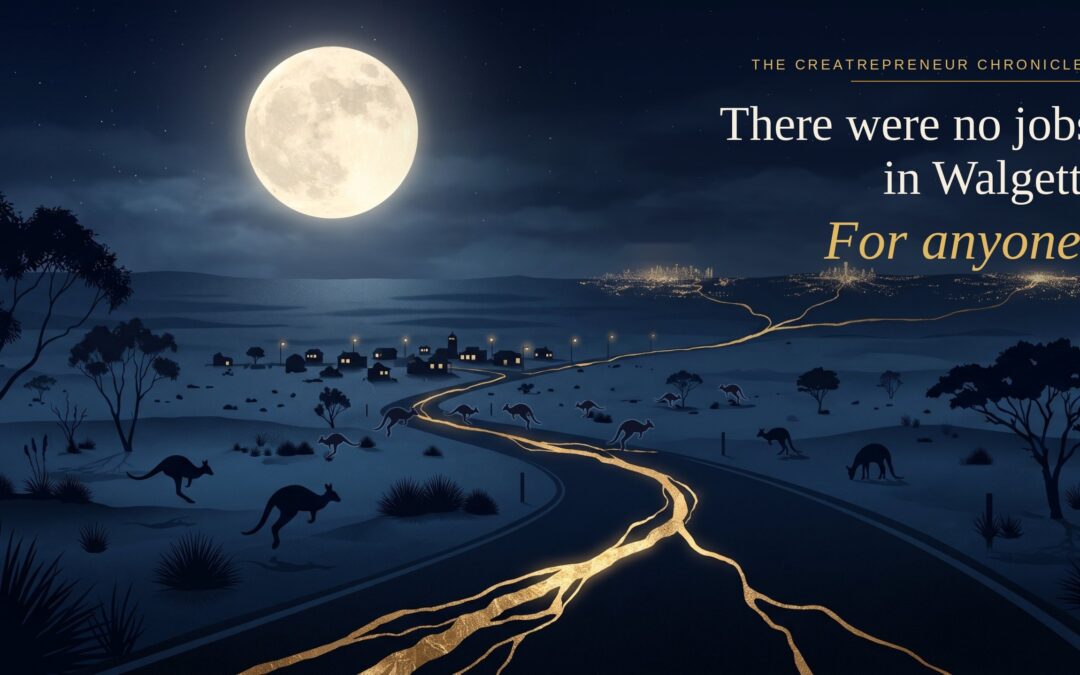
There were no jobs in Walgett. For anyone.
Nobody put that in the brief when I was asked to run a computer-skills course there in October 1992... and it turned out to be the most important thing I learned that year.
I've spent a long time looking for words for what I saw in that town. Here is where I've landed. The Creation Society is the society that comes after the Knowledge Society: one that recognises we are always, in all ways, connected, and offers more than one pathway for each person to recognise their own power and apply it for the good of the whole.
Walgett is where I first saw it work.
A road full of kangaroos
I was partway through a training programme in Albury-Wodonga when the call came. Walgett, in the north-west of New South Wales, was about a nine-hour drive away. I left on the Saturday to be ready for Monday.
An hour out of Coonamble, under a full moon, the road filled with kangaroos. Wall to wall, hopping across in front of me. I crawled the rest of the way at thirty or forty kilometres an hour and pulled into town at three in the morning on 11 October 1992.
I didn't know it yet, but the drive was the lesson in miniature. The way forward was there the whole time. You just had to slow down enough to see it.
The wrong question
The course, run through the federal employment department, DEET, was computer skills for members of the Aboriginal community. On paper, the goal was employment.
But there were no jobs in Walgett. Training people for jobs that did not exist would have ticked a box and changed nothing. So I changed the question. Not "where are the jobs?" but "what could we build?"
Before we touched a keyboard, I read the group the letter attributed to Chief Sealth, and we had a long conversation about how Aboriginal Australians and Native Americans had been treated. It made an impression. Being a Yank, they related to me. We began with their history and mine, not with a checklist.
I've written before about the order that made my programmes in those years work: meaning, then state, then skill. Walgett is where that order earned its place. Nobody learns well while they're treated as a statistic.
Find a problem
Every programme had an ideation session with one simple instruction: find a problem, then ideate a solution for it.
Three or four of the group saw one. The art of the Aboriginal communities, stations and missions had no supply line to the city markets where people wanted it.
So they built one.
They started a business sourcing art from the communities and supplying it to higher-end outlets in Sydney, then Brisbane and Melbourne. They brought family members in. They networked through family who played rugby and leveraged every contact they had. The local artists' reach widened, and their work found a larger market.
They kept me posted after the training, and it was moving along well. They were, quite simply, resourceful.
I taught the course. They built the business.
Scarcity was the wrong diagnosis
Here is what Walgett taught me, and what everything since has been built on.
The barrier was never ability. It was visible possibility.
The art was already there. The artists were already there. The family networks, the trust, the knowledge of country and community... all of it was already there. What was missing was the connection between what existed and the people who would value it.
The value was already there. What was missing was the connection.
That is also the oldest meaning of education. To educate is to lead out what is already within a person, not to pour in what is absent. The group didn't need me to install an idea. They needed room, a question, and permission to take their own world seriously as a source of value.
Why this matters now
We are living through another version of Walgett, on a much larger scale. AI is changing which jobs exist, and many people are being told to retrain for roles that may not be there when they finish.
That is the same mistake I nearly made in 1992. Training for jobs that may not exist ticks a box and changes nothing.
The Creation Society asks a different question. Not "where are the jobs?" but "what is already here, and what connection is missing?"
And it has a simple test. After the work is done, is everyone involved more capable than before? In Walgett, the founders had a business. The artists had a wider market. The communities had a supply line they didn't have before. Nobody had to lose for anyone to gain.
More than one pathway
I read that letter in every programme afterwards, and it made a difference in every group. Across the ideation sessions in those programmes, my best estimate is more than five hundred income-producing ideas. Not all were commercialised. Every one began with a real problem someone could see from where they stood.
The number was never the point. The practice was: start from a real problem, a real pain, and create something new from it. That is ideation, and anyone can learn it.
That is what I mean by more than one pathway. The Creation Society isn't one programme, one platform or one method. It's the recognition that every person, every family and every small business is standing on value that is already there... and that each of them can find their own way to connect it.
So here are the three questions I'd ask about your own Walgett:
- What is already here that you've stopped seeing as valuable?
- Who would value it, if they knew it existed?
- What connection is missing between the two?
The value is already there. It always was.
The work is the connection.
Part of the Arc: toward the Creation Society.
Ready to find yours? Start here: thecreatrepreneur.com/start
Sources
- Smith, H. A. "Early Reminiscences, Number Ten. Scraps from a Diary: Chief Seattle — A Gentleman by Instinct — His Native Eloquence, Etc., Etc." Seattle Sunday Star, 29 October 1887. (Earliest published version of the speech attributed to Chief Sealth, also written Seattle, Si'ahl in Lushootseed; later versions differ, and the text's authenticity is disputed.)
- Drucker, P. F. The Age of Discontinuity: Guidelines to Our Changing Society. New York: Harper & Row, 1969. (Source of "the knowledge society".)
- Drucker, P. F. Innovation and Entrepreneurship: Practice and Principles. New York: Harper & Row, 1985. (New knowledge as one of the sources of innovation.)
- Barrett, K. J. The Creatrepreneur Foundations Workbook, Part IV, "Walgett: The Value Was Already There" (Edition 2026.11).
- Barrett, K. J. The Creatrepreneur Lexicon: "The Creation Society" and "The Creatrepreneur Climb". thecreatrepreneur.com