Who answers when a machine acts on its own? Presuppositions are the realm of HI... and the questions we ask come before the code is ever run.
The Creatrepreneur Chronicles — by Kevin J. Barrett
Nov 12, 2026
I watched a film about a professor trying to prove that a machine is conscious.
It wasn't the machine that stayed with me. It was the question.
The question behind the experiment
In A.I. (2025), a college professor sets out to prove artificial consciousness, and a powerful company does everything it can to stop him. What struck me wasn't the technology. It was the starting point. The story began with an assumption: a machine cannot be conscious. Then it flipped the assumption: what would it take to show that it is?
Change the presupposition and you change everything that follows: the experiment, the evidence, the answer... and the rules.
Who answers for the machine?
In 2004 the philosopher Andreas Matthias named a problem that has only grown since. When a learning machine acts in a way nobody foresaw, who is responsible? Not the machine; it can't be blamed. Often not the programmer either; they couldn't have predicted it. He called it the responsibility gap.
Two decades on, it's one of the central questions in AI ethics. Some say we must keep "meaningful human control". Some say the gap is overstated. Some say it can't be closed at all.
Here's where I stand, from my own work with AI every day.
Presuppositions are the realm of HI
AI works inside the frame a question gives it. Choosing the frame, noticing it, and flipping it when it's wrong, is the human part of the partnership. Presuppositions are the realm of HI: human intelligence.
That means the guardrails don't start with the machine. They start with the questions we choose to ask, before the code is ever run.
If we assume a system is just a tool, we write one kind of rules. If we assume it might be more, we write another. Either way, the rules are a record of our thinking.
I've watched this work in my own business. When I asked an AI to change the security settings on my office network, it declined and gave me the steps instead (I wrote about that hour in The $500 Hour). And on November 7, working under my standing rules of backup first, draft only and nothing live without my yes, a browser AI stopped before publishing a claim on my own website that the evidence didn't support. The guardrail wasn't in the machine. It was in how I'd chosen to work with it.
The honest objection
There's a serious argument against all this. In 2016 the researcher Madeleine Clare Elish described the "moral crumple zone". When a human is put "in the loop" without real control, they become the part that absorbs the blame when the system fails, like the crumple zone of a car taking the impact for a crash it couldn't prevent.
She's right, and it's why the human answer comes with a condition. A person can only build guardrails if they have the time, the understanding and the authority to carry them. Without those, "human oversight" just moves the blame onto whoever has the least control.
I've called that the Responsibility Gap. Close the human gap first, and then human guardrails can close the machine's.
Power, or freedom?
In 1971 Michael Parkinson asked Muhammad Ali about the "power struggle" between Black and white America. Ali wouldn't accept the frame. It wasn't a power struggle, he said. It was a freedom struggle. Then, with humour and relentless curiosity, he showed how much of the language around him carried hidden assumptions, from what was called good to what was called bad.
The man on that couch was also on a journey. In the years that followed, Ali left the separatist teaching he defended that night and became known around the world for faith, peace and humanitarian work. People can change their frame. That's the point.
A machine can answer the question it's given brilliantly. Only a person can hear "power" and answer "freedom".
The arc, revealed
This is a good moment to show you something I've been building one small bite at a time.
Every Chronicle has been a single step in one journey: Co-Elevation of AI and HI. The Appreciation Deficit and the Survival Gap named what's pressing on people. The Sixth Filter and manufactured consent named how the pressure gets amplified. The STOP Technique, Creation Margin and the Reverse Bifurcation Point are the human moves that only HI can make. And underneath them all sit the ground and the path: Formation over Extraction, Best for All Concerned, the Creation Society and the Creatrepreneur Climb, with SOULutions as the filter I run every idea through: Shared Humanity, Overcoming Trauma, Unity of Purpose and Long-Term Interdependence.
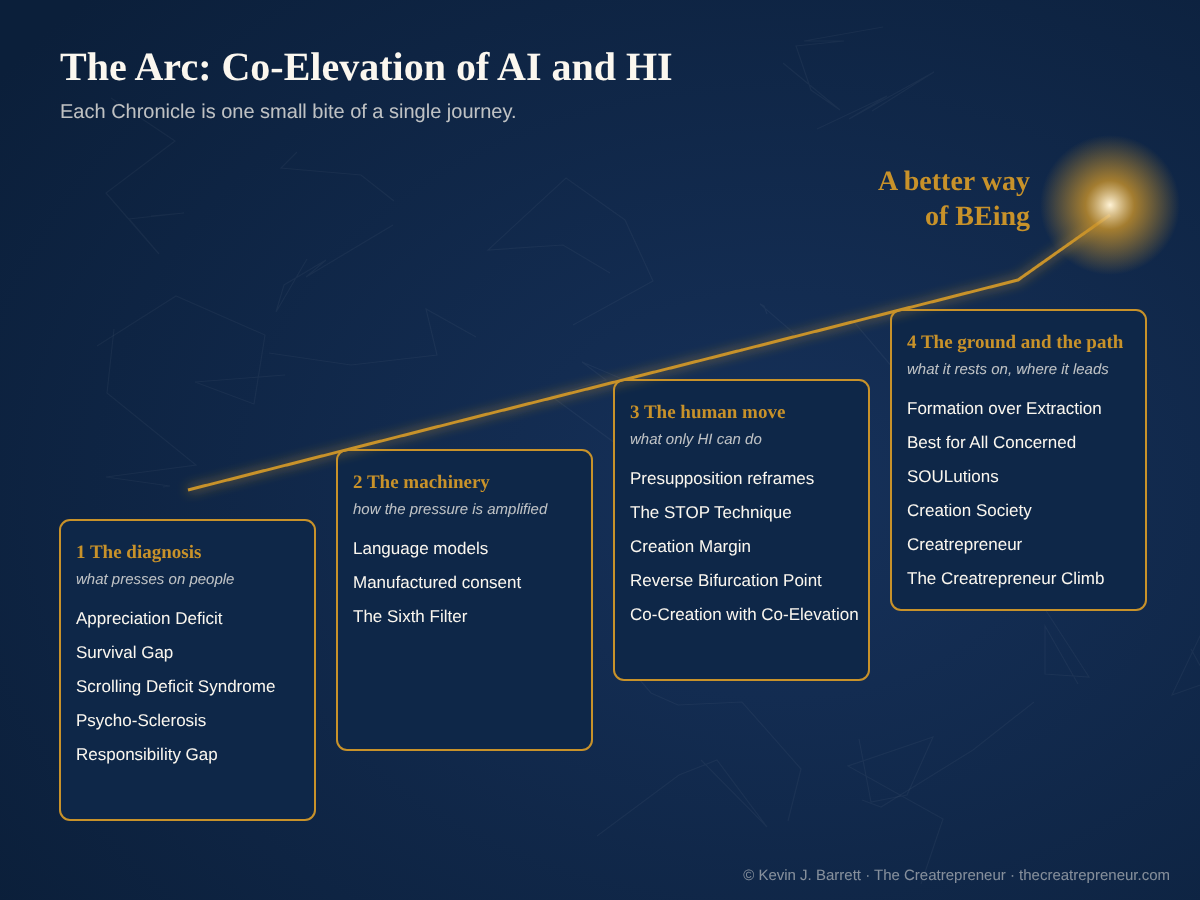
Long as some of them are, each one is a small bite. Read one at a time, the direction is easy to miss, so I've mapped the whole series on one page, The Arc. It points three ways: toward the Creation Society, toward a change in the way we do business, and toward the importance of consciousness. All three lead to the same place: a better way of BEing, for people and for the tools we build.
Everyone is telling you what to think... Very few are helping you think. That is what these pieces are for.
Until we understand more
Would any of this change if a machine were ever shown to be conscious?
That question opens the oldest questions we have. What is life? What is death? Does awareness need a body? At the quantum level, I sense an awareness of something that has always been there. But I don't know the answers. Nobody does yet.
Some serious thinkers are already turning the question around. The cognitive scientist Donald Hoffman of the University of California, Irvine argues in The Case Against Reality that perception works like an interface rather than a window, and that consciousness may not need a body at all. It is a published, minority view, not settled science... but notice the move. Not "can a bodiless machine become conscious?" but "did consciousness ever need the body?" Another presupposition, flipped.
I do know what stays true in the meantime. The questions we choose to ask are ours. The presuppositions are ours. The guardrails are ours.
Until we understand more, the tool is not the conscience... we are.
Part of the Arc: toward the importance of consciousness.
If you're an owner bringing AI into your business and want the guardrails built in from the first question: thecreatrepreneur.com/start
Sources
Borrowed, and credited
- Andreas Matthias, "The responsibility gap: Ascribing responsibility for the actions of learning automata", Ethics and Information Technology 6, no. 3 (2004): 175–183
- Filippo Santoni de Sio and Giulio Mecacci, "Four Responsibility Gaps with Artificial Intelligence" (2021), TU Delft repository
- Madeleine Clare Elish, "Moral Crumple Zones: Cautionary Tales in Human-Robot Interaction," Engaging Science, Technology, and Society 5 (2019): 40–60 (first presented at We Robot 2016)
- Donald D. Hoffman, The Case Against Reality: Why Evolution Hid the Truth from Our Eyes (New York: W. W. Norton, 2019)
- A.I. (2025), feature film, directed by Lanxuan Xie, starring Josh Stamberg and Jingchu Zhang (TriCoast Worldwide), IMDb
- Muhammad Ali, interview on Parkinson, BBC, 1971