
An MIT mathematician just solved a decades-old problem with AI in the room. Then he told the world what he's teaching his students instead of answers.
The Creatrepreneur Chronicles — by Kevin J. Barrett
Oct 21, 2026
The machines are getting very good at answers.
That sentence is no longer a prediction. This month, AI systems produced solutions to open problems that had stumped mathematicians for years... and one of the people standing closest to that frontier went on television to say something that should stop every parent, teacher and business owner mid-scroll.
The answer was never the point.
A lineman, a conjecture and a machine in the room
John Urschel used to block for the Baltimore Ravens. He left the NFL to pursue mathematics, and today he teaches at MIT.
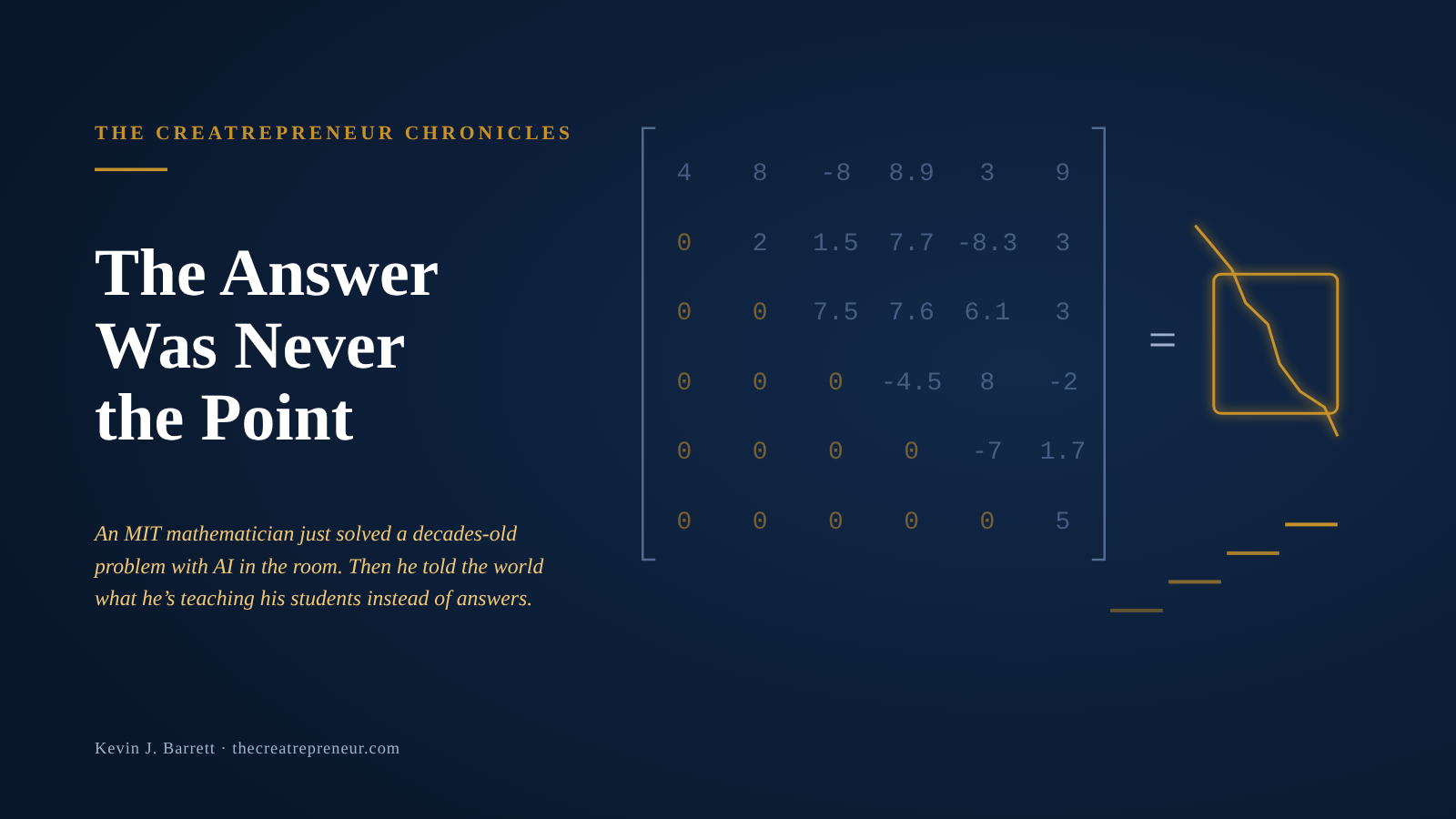
This month he resolved a conjecture from the 1990s about Gaussian elimination, the same "elimination method" most of us learned in school for solving a few equations at once. Our computers run it, as he put it, "billions, trillions, maybe even quadrillions of times a day." The question was whether we can trust it at scale. His answer, for random matrices: yes, the numbers stay well behaved.
Here's the detail most of the coverage skipped. His paper carries an AI Usage Statement. It says the research is "the result of human–AI interaction," that he began with "a human-only proof sketch" for part of the problem, and that it was "improved to a proof for all entries through AI interaction." He wrote the manuscript himself.
Asked about the eureka moment, he said there wasn't one. No light bulb over a pint at the bar. "It's slow and steady math progress... really the biggest thing is slow and steady understanding."
The human brought the depth. The machine extended the reach. The human owned the result.
What he teaches instead of answers
On Amanpour & Co. with Walter Isaacson, Urschel was asked whether AI solving these problems means we lose the human journey of solving them. He didn't hedge.
"The point of being a mathematician was never just to produce proofs of things... the important part is that you extract understanding."
Then he named the danger: "the more that people just purely rely on these tools, the less they hone their own ability to think." Picture a generation or two from now, he said, where people simply aren't thinking for themselves. A really scary situation.
So what does he teach? Not prompt tricks. Not how to outsource the homework. "My main role... is how to think for themselves," so they can "decide what they believe is true, what they believe is not." Those skills, he said, were needed a hundred years ago, are needed now, and will be needed a hundred years from now.
And then he described the world our children are scrolling through, better than I have:
Information has never been easier to reach. "It has never been easier to teach yourself." And yet, with so many things vying for our attention, so many things that want to do our thinking for us, "it's never been harder to actually sit yourself and try to learn... and do things the hard way."
That's the Scrolling Deficit, described from inside an MIT classroom.
The step after understanding
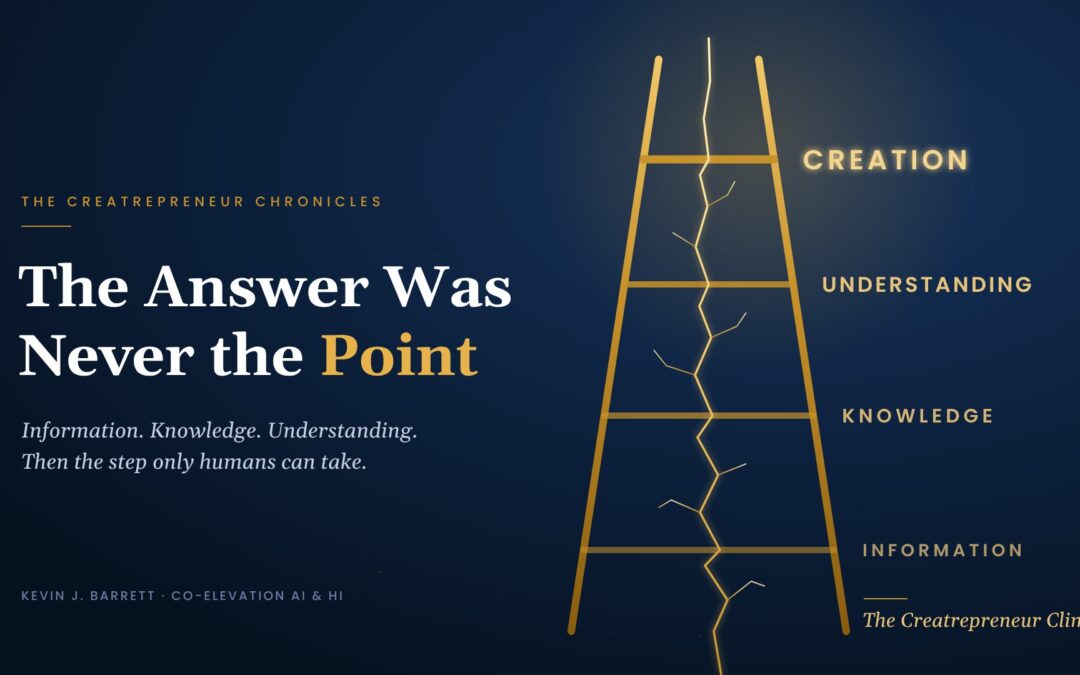
Listen closely and Urschel is describing a ladder.
- Information: everywhere, free, one search away.
- Knowledge: information you've taken in and can use.
- Understanding: knowledge you've wrestled with until you see why, and can carry to the next problem. That's where he stops, and he's right to plant his flag there.
I want to add one rung.
- Creation: understanding put to work on something that didn't exist before.
I call the whole sequence The Creatrepreneur Climb. And it isn't a new thought for me. In "12 Faces of the Millennium," written in 2000, I wrote: "I personally believe we have already passed through the Knowledge Society into what I call the Creation Society." A quarter-century later, the machines have made that line literal. When knowledge is a commodity a machine can hand you in seconds, the human contribution moves up the ladder: to understanding first, and then to creation.
I'm not the first to draw a ladder like this. Educators have worked from the information-to-wisdom pyramid for decades, and the revised Bloom's taxonomy puts Create at the very top of learning. What Urschel's moment shows is why that top rung just became urgent. AI can produce things, but creation built on earned understanding is the human step.
You can't create from answers you were handed. You can only create from understanding you earned.
Urschel gave an example of his own. One of the problems AI recently solved sat in free probability, a whole field of mathematics that a professor more or less created while trying to crack that very problem. The field went on to be used far from where it started. As Urschel put it, progress toward a problem "can sometimes be more important than the solution." The journey didn't just produce understanding. It produced creation.
Co-Elevation, in a math department
Urschel never used my term. He didn't need to. What he described, in his paper and in his classroom, is what I call Co-Elevation AI & HI: artificial intelligence carrying the volume, human intelligence supplying the understanding, the judgment and the final word. It extends Keith Ferrazzi's idea of co-elevation, people committing to rise together, to the partnership between people and their machines.
It isn't only for mathematicians. I see the same pattern every week in small businesses, including my own. The owner who hands everything to the machine gets answers they can't check and a business they no longer understand. The owner who refuses the machine gets left behind. The owner who works with it, setting the intent, letting AI do the reading and the heavy lifting, and keeping their hand on every decision that matters, gets something better than either: understanding that compounds, and the capacity to create.
The sequence matters. Understand first... then create. Skip the first and the second is just borrowed work with your name on it.
When a student tells Urschel "ChatGPT told me," he isn't hearing understanding. He's hearing someone standing on the second rung, mistaking it for the top.
The journey is the asset
The machines will keep getting better at answers. Every three to six months, Urschel says, there's another breakthrough. Nobody knows where it ends, and he's wise enough not to guess.
But wherever it ends, the people who thrive will be the ones who did the climb: who turned information into knowledge, knowledge into understanding... and understanding into something new.
That climb is what I help owners make, with the machine beside them, not in their seat.
If you want to start, start here: thecreatrepreneur.com/start
Sources
- John Urschel, interview with Walter Isaacson, "NFL Player Turned Mathematician Solves Problem that Eluded Scholars for Years", Amanpour & Co., aired October 21, 2026 (PBS/CNN; viewed via Hulu).
- John Urschel, "On the Growth Factor of Random Matrices", arXiv:2610.06785, October 2026, including its AI Usage Statement.
- "NFL Player Turned MIT Math Professor Urschel Visits Bowdoin Campus", Bowdoin News, February 2026 (source of "ChatGPT told me").
- Kevin J. Barrett, "12 Faces of the Millennium," written 2000, published 2005.
- Lorin Anderson and David Krathwohl (eds.), A Taxonomy for Learning, Teaching, and Assessing (revised Bloom's taxonomy), 2001.
- Keith Ferrazzi, Leading Without Authority, 2020 (co-elevation).