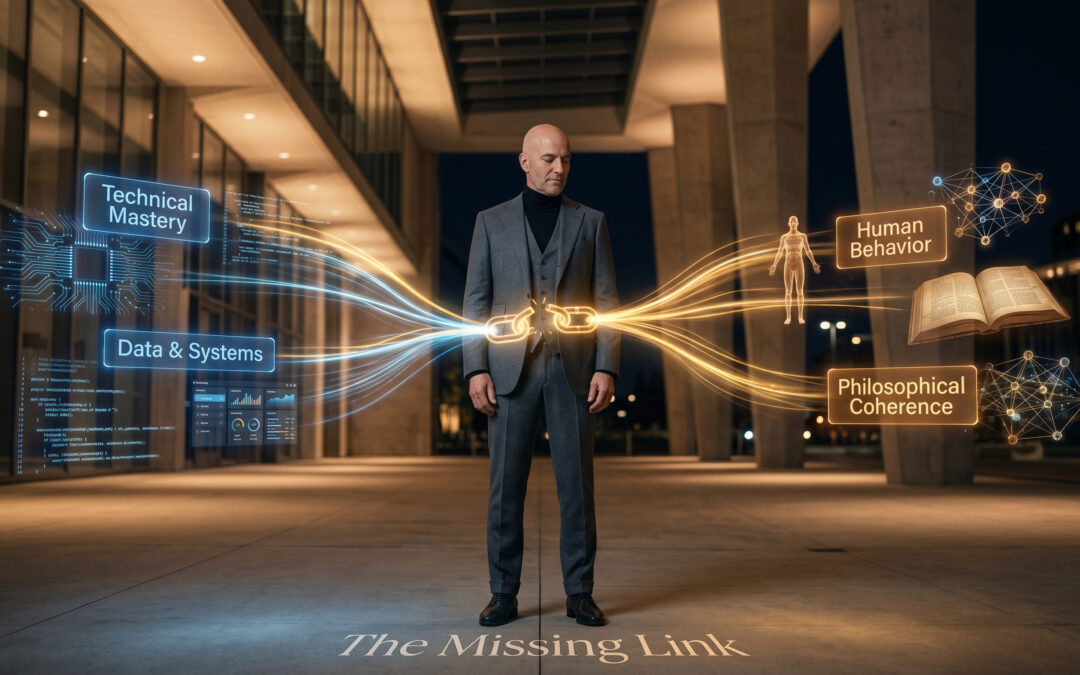
The Missing Link: Why Technical Mastery Without Philosophical Coherence Always Comes Up Short
By Kevin Barrett · May 2026 · KJ Barrett & Associates
"Not my first rodeo."
Most people say that as a deflection — a polite way of signaling that they've been around long enough not to be impressed. I mean it differently. I mean that the patterns I see playing out in boardrooms, startup calls, and marketing meetings today are patterns I recognized thirty years ago, in different industries, on different continents, under different pressures.
The technology changes. The human patterns don't.
This edition of the Chronicles is about a gap I keep encountering — a gap that exists at every level of business, from funded startups to Fortune 500 companies. It's not a gap in knowledge. It's not a gap in skill. It's a gap in coherence. And until you see it clearly, you won't understand why the most technically capable people in the room are often the ones who can't explain why what they're building doesn't convert, doesn't retain, and doesn't last.
The Room That Keeps Repeating Itself
I have sat in a version of this room dozens of times across my career.
Someone has built something technically impressive. The platform works. The infrastructure is sound. The team is capable. The data is being collected. And yet — the question nobody can answer is why the people who visit don't come back. Why the people who sign up don't engage. Why the people who engage don't convert.
The answers that emerge in these rooms follow a predictable pattern. The email is going to spam. The funnel needs optimization. The landing page needs A/B testing. The SEO needs work. The ads need better targeting.
All of those things may be true. None of them is the root cause.
The root cause is almost always the same: the people who built the platform understand the technology but not the human being on the other end of it. They can tell you exactly how data flows through their system. They cannot tell you what the person arriving at their homepage is actually afraid of.
|
A recent example from my own work — without naming names: A colleague asked in a team meeting: "Why can't we see who is signing up for our Student Site Evaluation?" The founders answered with a discussion about email deliverability, spam filters, and disassociated links. The marketing team nodded. The meeting moved on. The actual answer: there is no connection between the platform and the CRM. Traffic goes in. Nothing comes out. The email deliverability discussion, while not entirely wrong, was a technical answer to a strategic question — and it prevented the real conversation from happening. The room moved on because nobody had a framework for naming what was actually missing. |
The MarTech Stack Is Not the Strategy
I want to be precise about something, because I have deep respect for the professionals who work in marketing technology. There are people in the MarTech space, in digital transformation consulting, in the startup ecosystem, who are genuinely sophisticated. They understand funnels. They understand attribution. They understand behavioral email sequences, webhook architecture, CRM segmentation, and the technical infrastructure that makes modern marketing work.
What most of them don't have is a framework that answers the question underneath all of those capabilities: why does this particular approach serve the person on the other end?
Without that framework, you end up optimizing for metrics that feel good but don't mean what you think they mean. You optimize open rates and miss the fact that the people opening your emails aren't the people who buy. You optimize click-through rates and miss the fact that the people clicking are hitting a wall when they arrive. You build a technically perfect nurture sequence for an audience that never trusted you in the first place.
The technical layer is necessary. It is not sufficient. And the missing piece isn't more technology — it's coherence.
What Coherence Actually Means
Coherence is not consistency. Consistency means doing the same thing repeatedly. Coherence means that your tactics, your strategy, your positioning, your pricing, and your ethics all point in the same direction — that each decision you make emerges from the same underlying set of values rather than from what happened to work last quarter.
Here is what coherence looks like in practice:
When you write a marketing email, coherence asks: Does this give the reader something back, or does it take something from them? An email that creates anxiety to drive a click is technically functional. An email that delivers genuine value and earns the next conversation is coherent.
When you build a lead magnet, coherence asks: Is this the most useful thing I can give this specific person at this specific moment in their journey — or is this the most useful thing for getting their email address? Those are often not the same question.
When you design an onboarding sequence, coherence asks: At what point does the product demonstrate enough value that the user experiences an aha moment — and is our sequence designed around that moment, or around our revenue timeline?
When you respond to resistance in a meeting, coherence asks: Is pushing back here in service of the outcome, or is it in service of being right? Sometimes the most strategic thing you can do is go quiet and let the question hang in the air until the room hears it clearly.
None of those questions are technical. All of them affect the technical decisions you make next.
The Creatrepreneur Framework as Connective Tissue
The Creatrepreneur model exists because I kept watching technically capable people arrive at the same ceiling — the point where more skill, more tools, and more budget stopped producing proportionally better results. And I noticed that the people who broke through that ceiling weren't the ones who added more capability. They were the ones who got clearer about why.
The SOULutions framework — Shared Humanity, Overcoming Trauma, Unified Purpose, Long-term Interdependence — is not a list of values to put on a website. It is a diagnostic tool. When a product isn't converting, I run it through the framework:
|
Shared Humanity: Does the product acknowledge the actual human experience of the person it serves — or does it treat them as a user profile to be optimized? An educational platform that serves students but makes the student the last person who can initiate the relationship has a Shared Humanity problem. Overcoming Trauma: What is the fear, frustration, or prior failure that brings this person to us? Have we designed the entry experience around their actual emotional state, or around our preferred onboarding flow? Unified Purpose: Are the platform team, the marketing team, the partner program, and the user all moving toward the same outcome — or are they solving different problems in different directions without a shared definition of success? Long-term Interdependence: Is the revenue model designed around the user succeeding — or around the user continuing to subscribe? These are not always the same thing, and the difference between them compounds over time. |
When I run a conversion problem through that framework, I usually find the answer faster than any A/B test would produce it. Not because the framework is magic — but because it forces the right questions before the tactical work begins.
The 1% Is Not About Knowledge — It's About Integration
I'll be direct about something, because this Chronicles has always been a space for candor.
The intersection of technical fluency and philosophical coherence is genuinely rare. Not one-in-ten rare. Rarer than that. There are people in the MarTech space who are more technically sophisticated than I am. There are philosophers and ethicists who think more rigorously about the questions I'm raising here. There are organizational psychologists who understand team dynamics at a deeper level than I can claim.
What is rare is integration — operating fluently across all of those domains simultaneously, with a coherent framework underneath that makes the ethical decision and the strategic decision the same decision.
I know what that intersection looks like because I've spent thirty-five years building it. Not by accident — by design. Because I kept noticing that the most sophisticated technical practitioners in any room I walked into were missing a layer, and that the missing layer was always the same one: a reason why that could withstand scrutiny beyond "because it worked."
|
The proof is not in the claim. It's in the decisions. When I frame a marketing email as a gift rather than a pitch — that's the framework. When I go quiet in a meeting rather than winning the argument and losing the relationship — that's the framework. When I diagnose a conversion problem as a values misalignment before I look at the funnel metrics — that's the framework. When I recognize that a compliance regulation and a marketing optimization are actually the same problem — that's the framework. You can't fake that level of integration. You can't shortcut it. And you can't buy it from a MarTech platform, no matter how sophisticated. |
What This Means for You
If you're reading this as a founder, a marketer, a consultant, or a technologist — here is the question worth sitting with:
"When I make a decision about how to reach my audience, am I making it from a coherent framework — or from whatever worked last time?"
Most people, if they're honest, will answer the latter. Not because they're incapable of the former — but because nobody ever gave them a framework that made coherence the default rather than the exception.
That is what the Creatrepreneur model is designed to do.
Not to replace your technical skills. Not to slow down your execution. But to give you a lens through which every tactical decision gets made in relationship to your values — so that the person on the other end of your marketing, your product, or your pitch feels the difference between being served and being processed.
That difference is not measurable in a single campaign. It is profoundly measurable over time. In retention. In referrals. In the kind of trust that makes a 67% email open rate possible from an audience that's worked 70 hours that week and almost didn't open anything.
The Rodeo Metaphor
I said at the top that this isn't my first rodeo. Here's what that actually means in the context of this article:
I have been the person in the room who understood the connections that others didn't. Not because I was smarter — but because I had a framework that let me see across multiple layers simultaneously. And I have learned, sometimes painfully, that seeing the connection isn't enough. You have to know when to name it and when to let it land on its own.
The most powerful thing coherence gives you isn't the ability to be right. It's the ability to be patient. To trust that the question the room hasn't asked yet will eventually get asked — and that when it does, you'll have already built the answer.
"Piano piano si va lontano." Slowly, slowly, one goes far.
That's not a consolation. That's the operating principle of anyone who has been doing this long enough to know the difference between a sprint and a marathon — and who has the framework to sustain both simultaneously.
Kevin Barrett
Governance Board, Qoollege · KJ Barrett & Associates · thecreatrepreneur.com
May 2026
P.S. — The Audit is the first rung of a ladder. When you're ready for the climb — the $27 Quick Start, the $50 Foundations Workbook — it all lives at thecreatrepreneur.com/start. No pressure and no countdown timer. The rung is simply there when you reach for it.
Every Chronicle is free, and will stay that way. When you're ready to move from reading to building, start here: thecreatrepreneur.com/start.
The Creatrepreneur Chronicles is published by Kevin Barrett as a contribution to the growing conversation about ethical business, human-centered technology, and the Creation Society. Subscribe at thecreatrepreneur.com.